Physical Address
304 North Cardinal St.
Dorchester Center, MA 02124
Physical Address
304 North Cardinal St.
Dorchester Center, MA 02124

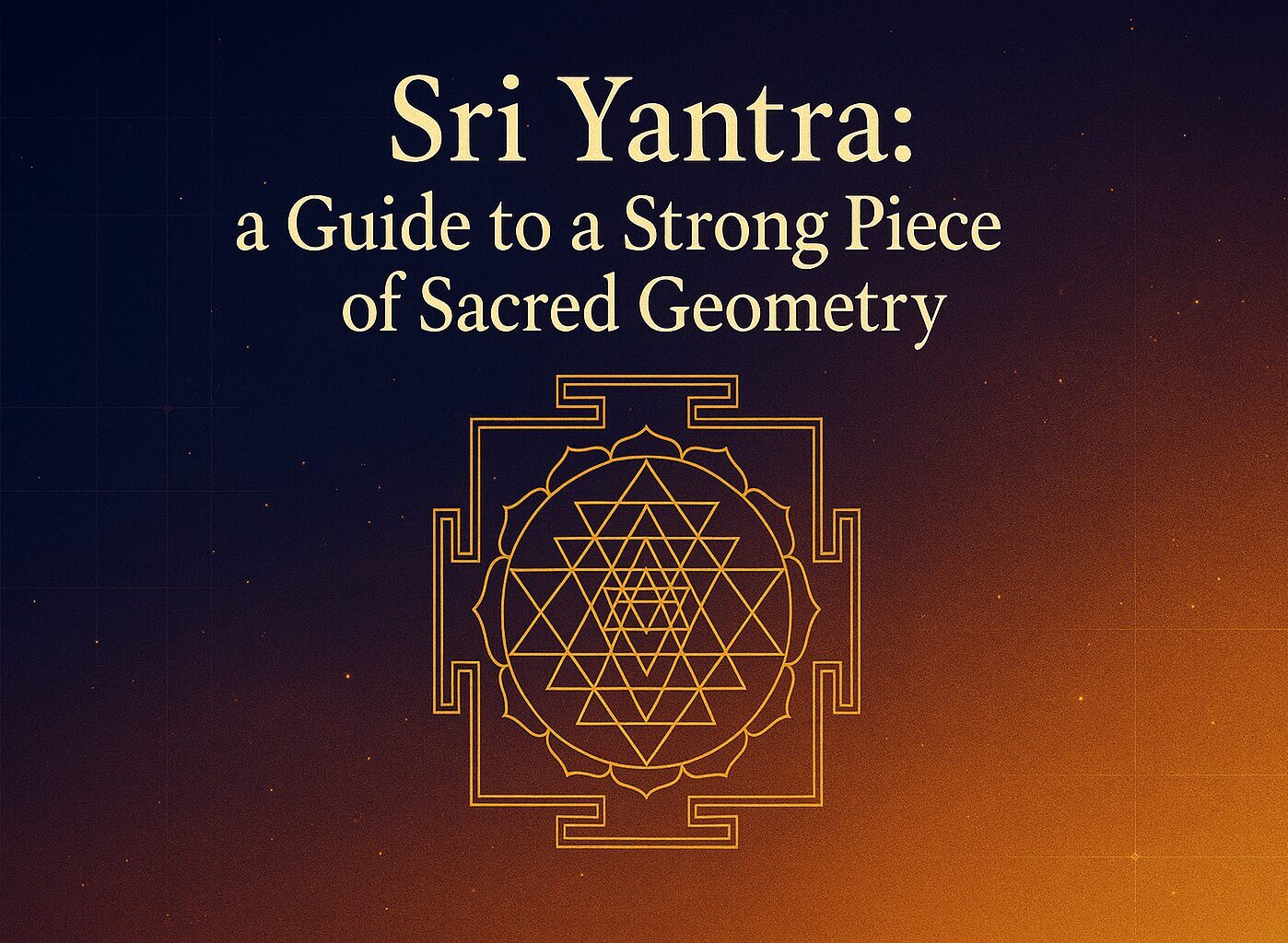
The Sri Yantra is a sacred geometric symbol in Hinduism and is considered one of the most powerful and auspicious yantras (mystical diagrams). It is often used in meditation and spiritual practices, symbolizing the universe and the divine feminine energy.
If you’ve ever spotted a striking triangle-on-triangle design and felt drawn in, you’ve probably seen the Sri Yantra.
This ancient geometric pattern shows up in meditation rooms, yoga studios, and even on personal desks because its precise, rhythmic lines help the mind settle quickly.
In this guide, we’ll break down the Sri Yantra meaning, explain how it’s sacred geometry works, and show you simple ways to use the it for meditation – whether you’re at home or on the move.
The Sri Yantra is a sacred geometric diagram made of nine interlocking triangles. Four face upward and five face downward.
Together, they form forty-three smaller triangles that radiate outward from a central point called the bindu.
Around this center, you often see lotus petals and a square “temple wall” known as the bhupura, with gates on all four sides.
Because every layer carries meaning, the symbol feels like a complete map of energy and focus.
The Sri Yantra symbol belongs to the yantra tradition of the Indian subcontinent. The word “yantra” literally means instrument or device.
In practice, that means the Sri Yantra works as a tool for attention. The way to work with the symbol is to engage with it, letting the lines guide your focus in meditation, ritual, or daily reflection.
Let’s zoom in on the Sri Yantra sacred geometry. The upward triangles represent active, solar qualities, while the downward triangles reflect receptive, lunar qualities.
When the two sets interlock, they create a balanced field of energy. Because the design is crisp and symmetrical, your eyes naturally follow clear paths.
As your gaze moves from the outer square to the lotus petals and finally into the web of triangles, your breath often begins to match that rhythm.
At the center, the bindu acts as an anchor. You can rest your eyes on it when thoughts feel scattered. Then, as you widen your focus to take in the entire Sri Yantra symbol, you experience a natural cycle of concentration and expansion.
This back-and-forth flow mirrors the way attention settles during meditation, making the Sri Yantra a practical tool for calm and focus.
The Sri Yantra belongs to a larger family of sacred diagrams used in Hindu and Tantric traditions. For centuries, teachers passed down its exact proportions, angles, and layer relationships with great care.
Because precision shapes the meaning, traditional artists draw the Sri Yantra using strict ratios that keep the geometry intact.
Today, modern prints and digital versions make the Sri Yantra symbol accessible to everyone. You don’t need to be a scholar to benefit from it.
Instead, you can simply place the image where you practice, breathe steadily, and let your attention rest on its lines.
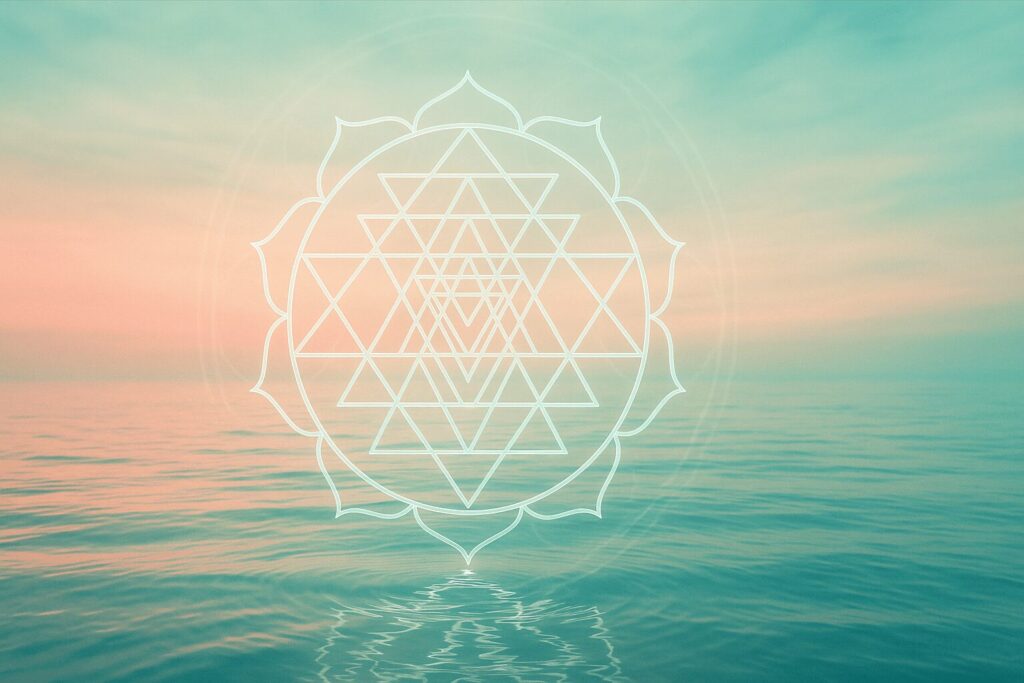
Begin with the outer edge of the Sri Yantra. The bhupura forms a square with four T-shaped openings, like gateways.
This outer frame sets a boundary and signals a threshold into sacred space. Moving inward, a ring of lotus petals unfolds. The lotus symbolizes growth, clarity, and unfolding awareness.
Next, nine interlocking triangles create a web of smaller triangles that seem to spiral toward the center. Because each layer draws the eye inward, your attention naturally settles on the bindu, the central point.
Each layer also shapes the mood of meditation. The square feels grounding and stable. The lotus feels soft and welcoming. The triangles add energy and direction.
As a result, spending time with the Sri Yantra meaning blends structure with gentleness, guiding both focus and calm.
Here’s a simple Sri Yantra meditation you can fit into a busy day. It works the same whether you use a print, a pendant, or even an image on your phone.
Sit comfortably with a tall spine and set a timer for eight to ten minutes. Place the Sri Yantra symbol at eye level. Breathe gently through your nose.
In the first minute, trace the square frame with your eyes. Next, shift to the lotus ring. Then follow the triangles as they pull your gaze toward the center.
Rest on the bindu, the central point, for three slow breaths. After that, repeat the cycle.
Because your eyes move with purpose, distractions fade. If thoughts interrupt, simply restart the sequence – square, lotus, triangles, center.
Add a short word like “clarity” or “calm” if you want extra focus. With daily practice, the rhythm becomes natural, and the Sri Yantra meaning unfolds as steady balance and concentration.
Many people use the Sri Yantra only for meditation, but the practice doesn’t have to stop there. Place a small Sri Yantra card on your desk and turn it into a quick two-minute reset between tasks.
Fix your gaze on the bindu while a page loads or while you wait for someone to join a call. On stressful days, trace the outer square with three slow breaths.
Because the design is compact, it also works perfectly as a phone wallpaper, giving you a micro-practice every time you unlock your screen.
You can also pair the Sri Yantra symbol with journaling.
Spend one minute looking at the pattern, then write a single sentence: “What would make the next hour easier?” The geometry clears mental clutter, while the sentence points you toward action.
Together, the two steps create a short ritual you can repeat anytime for focus and balance.
If you buy a print or pendant, check a few basics. The lines should be sharp, the angles clean, and the center aligned. Cheap distortions break the flow and feel distracting.
Meanwhile, hand-drawn or engraved versions usually carry a sense of care. If you enjoy DIY projects, try sketching the Sri Yantra symbol with a compass and ruler.
It takes patience, yet it teaches your hands what your eyes keep seeing – order leaning toward stillness.
If you want a sturdy piece for your altar or desk, here’s a solid option: Brass Sri Yantra.
Which direction should I place it?
Place the Sri Yantra at a height that meets your gaze when seated. Many people face it east during morning practice. If that’s tricky, face it wherever you’ll be consistent. Consistency beats perfect orientation.
How long should a session be?
Five to ten minutes works well. Because the pattern is dense, short sessions pack a punch. As your stamina grows, extend to fifteen minutes.
Is it a mandala?
It’s similar, yet the Sri Yantra sacred geometry follows strict ratios and a specific triangle count. Mandalas can be more freeform. Both can calm the mind.
Can beginners use it?
Absolutely. The Sri Yantra meets you where you are. Beginners enjoy the structure. Experienced meditators enjoy the precision.
What about mantras?
If you work with sound, you can add a simple mantra on the exhale. The combination of voice and geometry often deepens focus. Try it for a week and notice the difference.
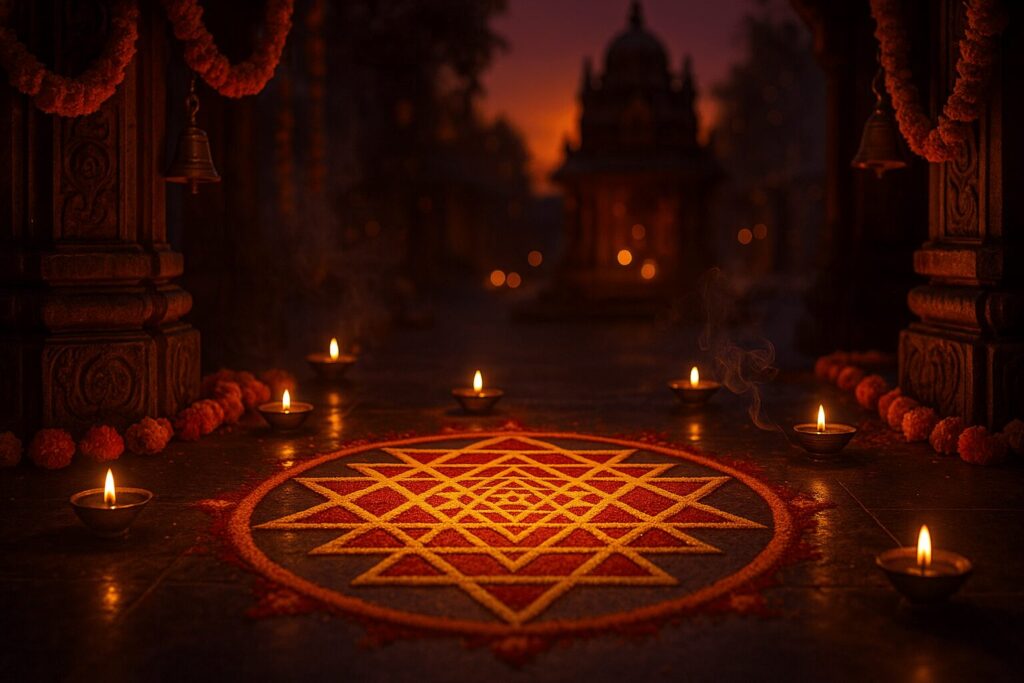
You don’t need to treat the Sri Yantra like a lab experiment, but a quick note adds context. Symmetry and rhythmic repetition naturally nudge the nervous system into calmer states.
Since the Sri Yantra sacred geometry is so precise and orderly, your eyes take in a clear and steady pattern.
As you look, your breath begins to sync with the design. In turn, your attention stabilizes. The effect usually feels subtle – less mental noise, more clarity and focus.
Two common issues show up in Sri Yantra meditation. First, people often get impatient with the center point and start squinting.
Instead, soften your gaze and let the bindu feel open and spacious. Second, beginners sometimes breathe too hard in the first minute and end up light-headed.
The fix is simple: keep the breath gentle and steady.
If you feel scattered, slow the process down. Spend a full minute tracing the outer square before moving inward.
On the other hand, if you feel drowsy, straighten your posture and brighten the room’s light. With Sri Yantra meditation, small adjustments make the entire session smoother and more effective.
The goal of Sri Yantra meditation is to make the symbol a reliable switch you can turn on anytime. Before a sales call, move your eyes through the sequence (square, lotus, triangles, bindu) three times.
After a tough gym session, lie down, breathe slowly, and rest your gaze on the image for two minutes.
When you start a fresh document, glance at the bindu, name your first action, and begin typing. Because the practice stays short, you can fit it into any part of the day.
At the same time, try sharing it with someone else. Sit next to a friend or partner with one Sri Yantra image between you.
Breathe together for five minutes while following the pattern. The shared rhythm creates a simple way to sync before a team meeting or a creative project.
Keep a Sri Yantra symbol near the place where you drop your keys, so you can pause for one breath before rushing out the door.
Place another on your nightstand to give your day a calm ending. Slip a slim Sri Yantra card into your travel wallet, and you’ll always have a quick practice ready in a hotel room.
Because Sri Yantra meditation doesn’t depend on apps, music, or sound, you can use it anywhere – at the airport, in a park, or even in the back of a rideshare.
The geometry works on its own, which makes it one of the most portable tools for focus and calm.
The Sri Yantra is a timeless tool for focus and balance. Rooted in centuries of tradition, it remains practical today because its lines guide your eyes and your mind with ease.
The Sri Yantra symbol draws your attention from the outer world toward the center and then back out again. Practicing Sri Yantra meditation gives you a steady routine you can repeat even on the busiest days.
Meanwhile, the Sri Yantra sacred geometry offers a clear structure when your thoughts feel scattered.
Start tomorrow morning with just five minutes. Trace the outer square, follow the lotus petals, and rest at the bindu.
Then carry that steady center into your day. Over time, you’ll reach for the Sri Yantra as naturally as you reach for a deep breath – simple, automatic, and always grounding.