Physical Address
304 North Cardinal St.
Dorchester Center, MA 02124
Physical Address
304 North Cardinal St.
Dorchester Center, MA 02124

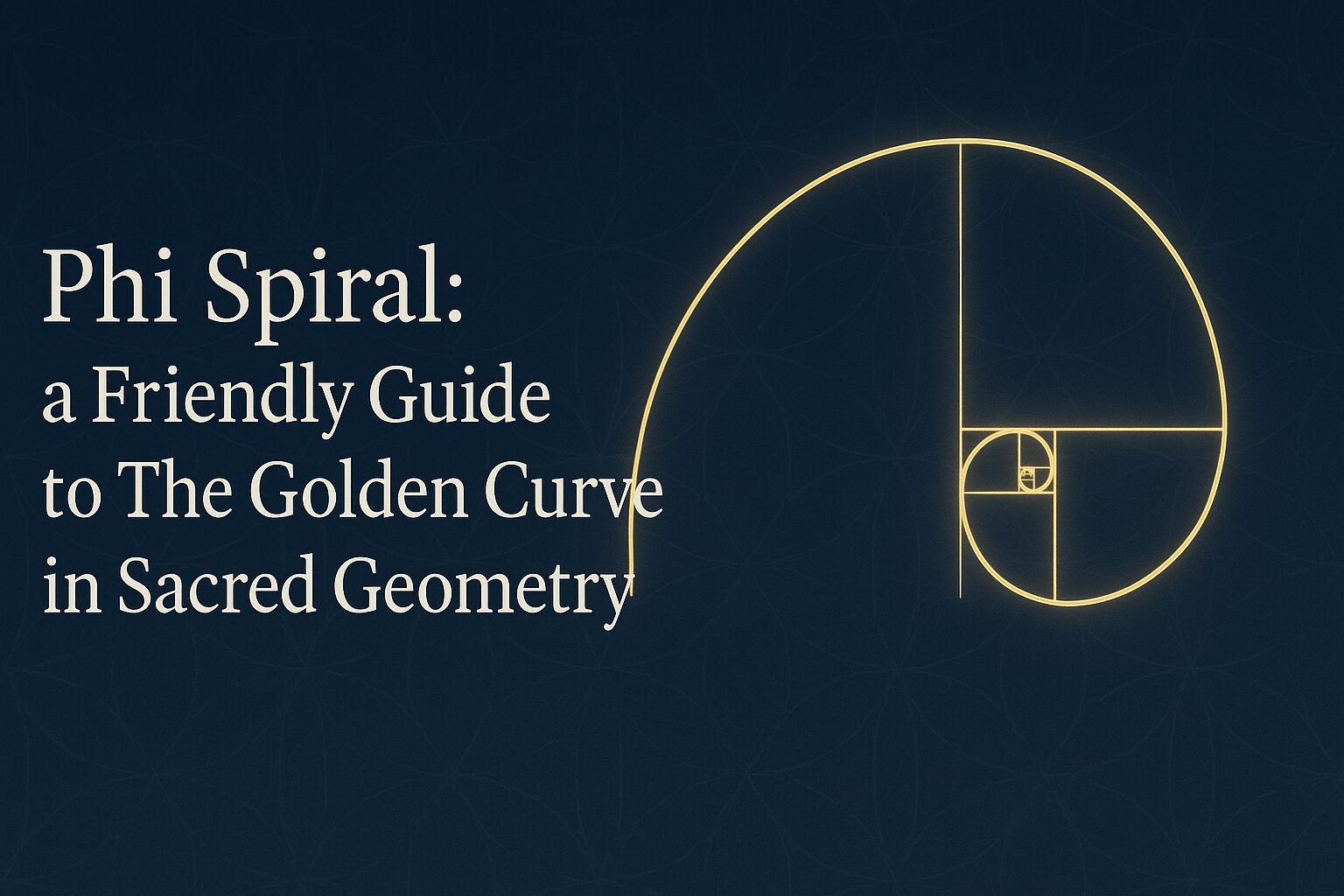
The Phi Spiral, also known as the Golden Spiral, is a logarithmic spiral that grows outward by a factor of the golden ratio (approximately 1.618) for every quarter turn it makes. This spiral is closely associated with the mathematical concept of the golden ratio, which has fascinated mathematicians, artists, and architects for centuries due to its aesthetically pleasing properties.
If you’ve ever noticed a seashell or a galaxy curling with perfect grace, you’ve already seen the pull of the Phi spiral.
In sacred geometry, the Phi spiral meaning points to growth, flow, and focus. Meanwhile, in mathematics, the same curve is known as the logarithmic spiral, and in design circles it’s often called the Golden ratio spiral.
As a result, when you see any of these names, remember they all describe the same powerful shape.
Furthermore, this guide keeps everything practical.
You’ll find a clear definition of the Phi spiral, a step-by-step method to draw it, and real-world examples of how artists and designers use the Golden ratio spiral in logos, layouts, and architecture.
Finally, we’ll clear up common myths and explain exactly where the Fibonacci spiral fits in – since that’s the curve most often mistaken for the Phi spiral.
The Phi spiral is a special kind of curve called a logarithmic spiral, and its growth follows the golden ratio (φ ≈ 1.618). That means two things.
First, “logarithmic” tells us the spiral grows by the same factor each time it turns.
Second, φ sets that factor.
As a result, the spiral keeps the exact same shape no matter how large it gets, which is why it looks so natural and balanced in shells, storms, and galaxies.
In sacred geometry, the Phi spiral meaning connects to steady, harmonious expansion. You can picture it as intention that grows smoothly outward, never rushed, never uneven.
Because the curve keeps a constant angle, the energy feels calm and consistent rather than jagged or chaotic.
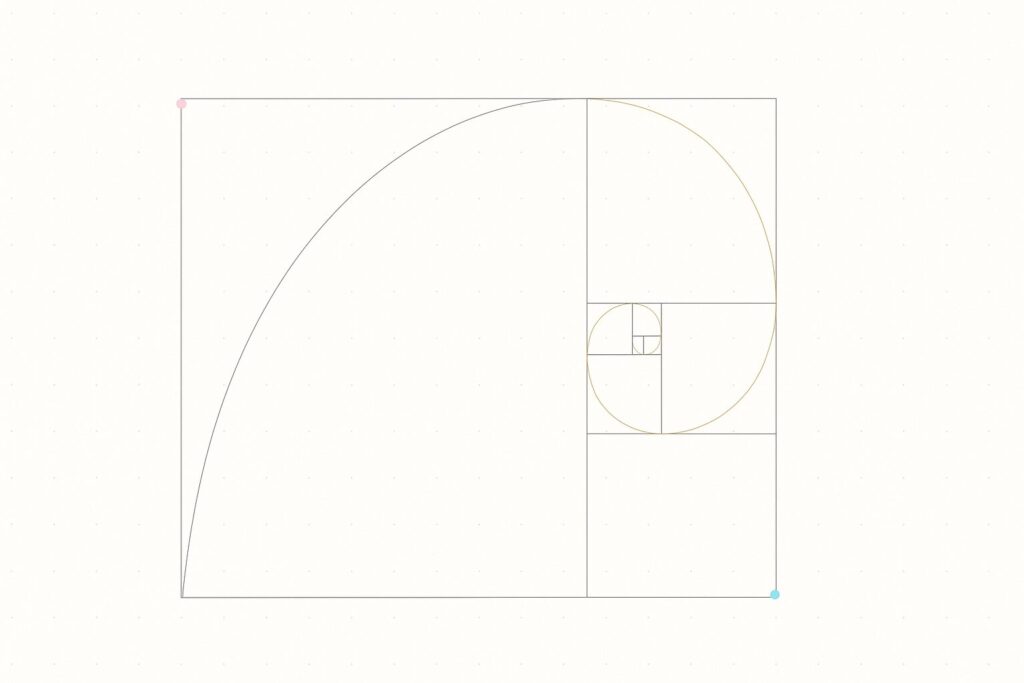
The Fibonacci spiral is built step by step with squares whose sides follow the Fibonacci sequence (1, 1, 2, 3, 5, 8 …). When you draw quarter-circles inside those squares, the result is a spiral that gradually approaches the Golden ratio curve.
In other words, the Fibonacci spiral is an approximation of the true Golden spiral.
By contrast, the Phi spiral is the exact Golden ratio spiral. On a poster or casual sketch, the difference is barely noticeable.
However, in precise design work – like a brand logo, a tattoo stencil, or a laser-cut pattern – the exact Phi spiral meaning matters.
For teaching, doodling, or quick layouts, the Fibonacci method is fast and easy. For professional geometry, stick to the Phi spiral.
When a shape grows larger but never changes its proportions, that’s called a logarithmic spiral. A Phi spiral works this way.
You see it in nautilus shells, succulents, hurricanes, and even galaxies. No matter the scale, the curve keeps the same shape, which is why the eye reads it as natural and balanced.
This “same shape at any size” quality makes the Phi spiral meaning practical for design.
For example, if you build a layout around the Golden ratio spiral, you can resize it for mobile, tablet, or desktop without breaking the flow.
The proportions stay smooth, and the design still feels right.
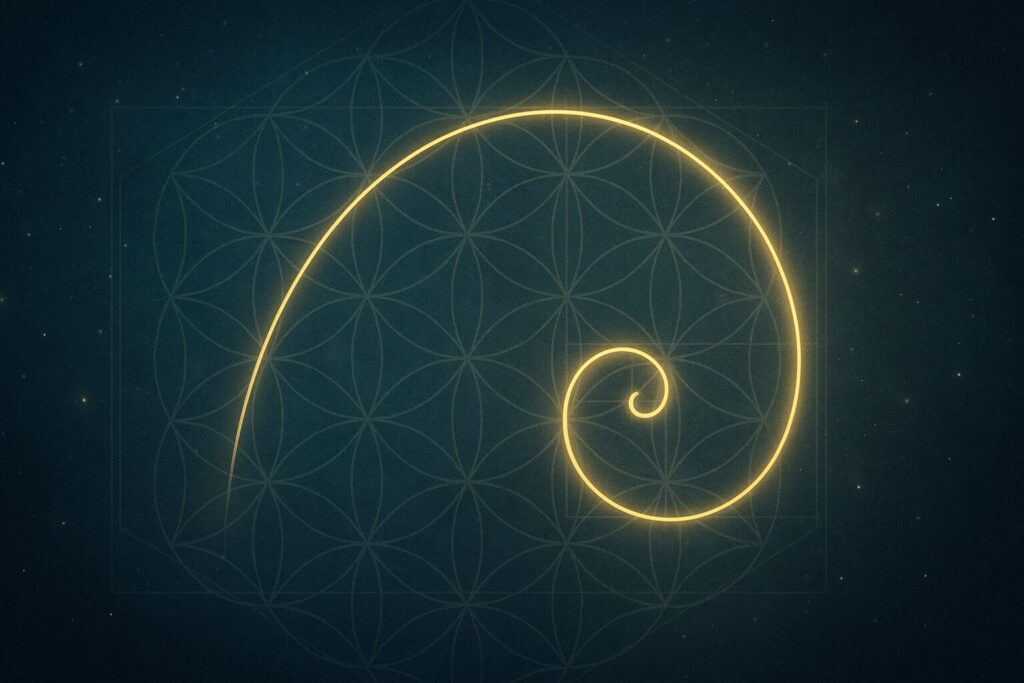
You can draw the Golden ratio spiral in two main ways. The quick classroom method is the Fibonacci spiral, which uses squares and quarter-arcs to get close to the shape.
The more precise method (the true Phi spiral) uses a constant angle, and here’s how to sketch it:
Because the radii increase by φ every time, the curve stays true to the Golden ratio spiral instead of drifting off.
If you’re using vector software, set your guides to φ multiples so the snapping feels natural and accurate.
In sacred geometry, the Phi spiral meaning often points to expansion with purpose – you grow outward while still holding your center.
That’s why the curve shows up on altar cloths, meditation journals, and crystal-grid boards. Practitioners trace the spiral slowly while repeating a single value, like “clarity” or “patience”, at each quarter turn.
The motion anchors the word to breath and focus.
For Phi spiral meditation, you can match the curve with a simple breathing rhythm: inhale for 3, exhale for 5, inhale for 8, exhale for 13.
The numbers come from the Fibonacci sequence, but the “magic” isn’t in the math – it’s in the steady increase. Your lungs expand in a smooth, memorable pattern, echoing the spiral’s flow.
If you want clean results without guesswork, this Golden Ratio & Spiral Template Set (transparent acrylic, multiple sizes) snaps your Phi spiral and layout grid into place: Golden Ratio Spiral Templates.
Logos and branding: A hidden Phi spiral can guide where lines, curves, and strokes fall, even if the spiral itself never shows in the final logo.
Because the curve always keeps the same angle, the design feels balanced whether it’s tiny on a card or large on a billboard.
Photography: Place the main focus, like the eye in a portrait, near the center coil of the Golden ratio spiral.
Let the hair, fabric, or background follow the spiral’s flow. This way, the viewer’s gaze naturally moves around the picture and settles on the subject.
Page and screen design: The Phi spiral shape can set where headlines, images, and white space sit. Start your main element close to the center and let smaller details follow the spiral outward.
The result feels smooth and easy to read.
Packaging: Wrap label text along a Golden spiral so the shopper’s eye moves from the brand name, to the flavor, to the story.
Because the spacing matches a natural growth curve, the design feels comfortable and inviting.
To draw a Phi spiral by hand, grab a compass, a ruler, and two pieces of cardstock.
Start by cutting one rectangle to about 100 mm by 62 mm, which is close to the Golden ratio (φ). Subdivide the rectangle, mark the quarter-arc points, and sketch a light guide curve.
Once it feels right, trace over it with one smooth, steady line. Use your wrist for gentle rotation rather than your elbow – you’ll feel the curve naturally fall into place.
If you want to share your work online, place the spiral next to a seashell or a seed head and snap a photo.
Label it as a logarithmic growth curve study in your caption so others immediately recognize the Phi spiral meaning behind the design.
“Everything in nature is the Phi spiral.”
Reality check: many natural spirals are logarithmic, but the growth factor varies. Some are closer to 1.7, others to 1.5. Therefore, call it a logarithmic growth curve unless you’ve measured φ specifically.
“Any spiral equals wisdom.”
Symbols gain meaning from context. A Phi spiral on a meditation card says “balanced expansion”. A jagged spiral says “tension.” Keep your intention clear, then pick the right curve.
“Fibonacci equals Phi.”
The Fibonacci spiral pattern is a great teaching tool. It approximates the Golden ratio spiral. However, it is not identical. If precision matters (laser cutting, CNC, or logomarks) use an exact build.
Breath work: Imagine the Phi spiral as a path. As you exhale, trace the spiral outward to let go; as you inhale, trace it inward to gather focus.
Since the direction changes the feeling, choose one way at the start and stick with it.
Journaling: Print a light Golden ratio spiral on your page. Write your bullet points or short sentences along the curve instead of in straight lines.
The spiral shape naturally keeps your notes short and focused.
Crystal grids: If you work with stones, place beads or small crystals along the arms of the Phi spiral shape moving outward. Then put one larger stone at the center coil.
This layout directs attention without looking messy.
Movement: Mark a Phi spiral on the floor or imagine one under your steps. Walk the curve slowly while breathing in a 3–5–8 rhythm. Your body starts to learn the same flow your eyes already recognize.
A circle loops back on itself. An ellipse feels stretched. A parabola shoots outward faster and faster. But the Phi spiral keeps widening at the same steady angle, which is why it feels smooth and inviting.
In design, that makes the Golden ratio spiral perfect when you want the eye to travel into a subject rather than crash straight into it.
By contrast, a sharp diagonal line feels urgent, it grabs attention and stops the gaze. The Phi spiral shape, on the other hand, guides the viewer in gently, making the approach feel calm and natural.
Is the Phi spiral the same as the Golden ratio spiral?
Yes. The Phi spiral grows by φ each quarter turn and keeps a constant angle. That is the Golden ratio spiral.
Where does the Fibonacci spiral pattern fit in?
It’s an approachable construction that converges toward the Phi spiral. Great for teaching and sketches; less ideal for precision work.
Is this a scientific law?
No. It’s a mathematical spiral design used in nature and art. Some shells and plants follow it closely; others use different growth factors.
Can I use it in UX or layout?
Absolutely. Map the coil to the user’s reading path, then place key actions near the inner turns.
The Phi spiral is one of the clearest ways to show calm, steady growth. Mathematically, it’s a constant-angle logarithmic curve shaped by the golden ratio φ.
In sacred geometry, the Phi spiral meaning connects to breath, balance, and expansion without chaos. You can sketch it by hand, build it in vector software, or drop it into a printed grid to guide your work.
If you’re teaching, start with the Fibonacci spiral to show the idea, and then reveal the exact Golden ratio spiral for precision.
If you’re designing, meanwhile use a proper template so your mathematical spiral design stays clean from the first sketch.
Finally, if you’re practicing, simply trace the curve as you breathe and let its rhythm ground you; because the Phi spiral shape scales endlessly without losing its form, your focus (and your projects) can grow the same way: smooth, strong, and aligned.