Physical Address
304 North Cardinal St.
Dorchester Center, MA 02124
Physical Address
304 North Cardinal St.
Dorchester Center, MA 02124

If you’re thinking about getting Norse tattoos, you’re exploring a world of bold geometry, powerful saga myths, and rugged blackwork styles.
In this guide, you’ll find a clear overview of Norse tattoo history, the most popular Norse symbols, and practical tips on how to design tattoos that age well.
Most importantly, you’ll learn what each Norse symbol means and why people still choose these designs today.
Authentic Norse tattoos draw inspiration from real artifacts like rune stones, Viking wood carvings, metalwork, and woven patterns from the early medieval period.
Designs that echo those lines, interlace patterns, and mythic motifs stay truest to the original Norse style.
Of course, there’s no ancient tattoo manual sitting in a museum. Modern artists translate the look of stones and tapestries into ink on skin.
That’s why the best authentic Norse tattoos start with a reference image. For example, you could tell your artist, “This border is from the Jelling stone in Denmark”, or “This knot comes from the Oseberg carving”.
Clear references keep the tattoo grounded in history while giving it personal meaning.
If you’re searching for Norse tattoos and their meanings, here’s a quick guide in one sentence each.
Vegvísir, the Viking compass, is a wayfinder symbol for staying on course.
Ægishjálmur, also called the Helm of Awe, represents protection and courage.
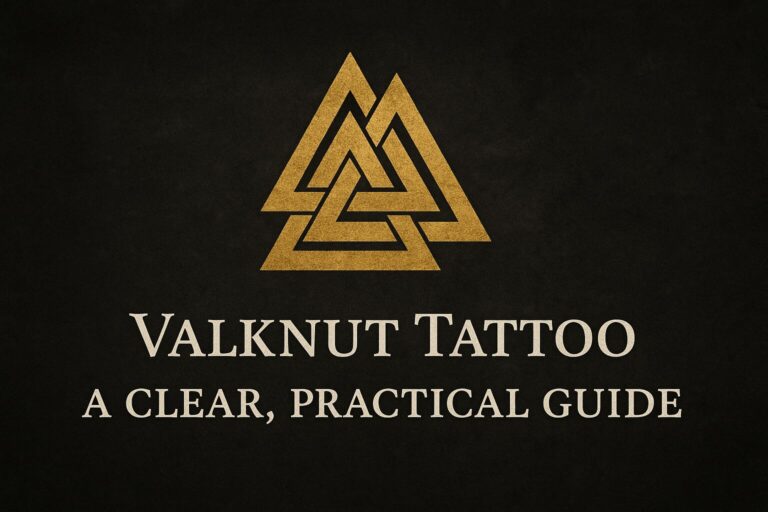
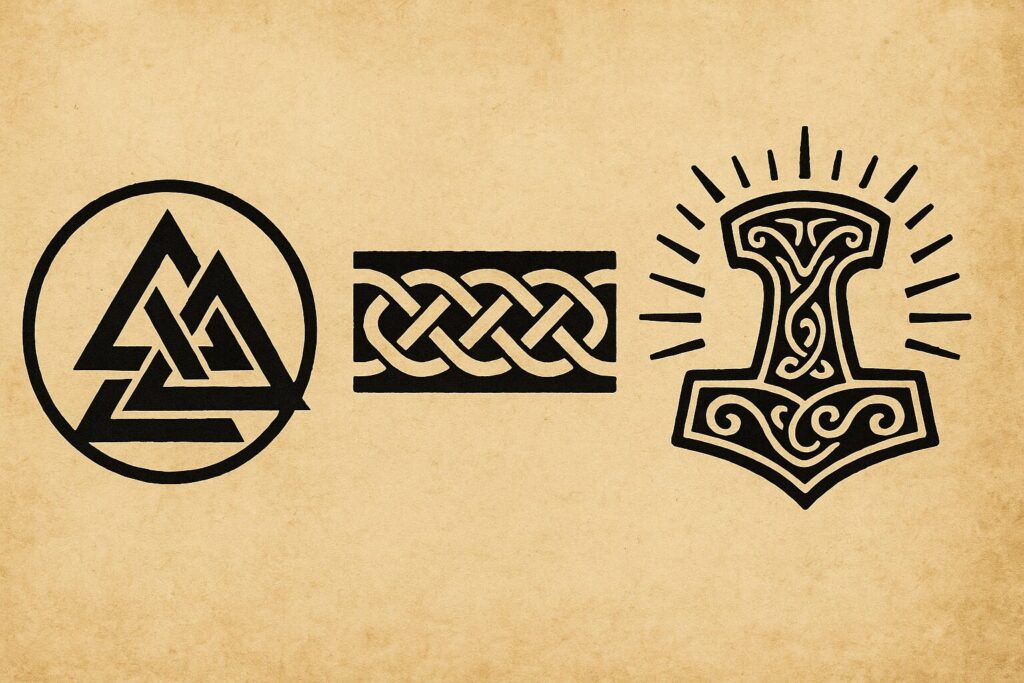
The Valknut, three interlocked triangles, symbolizes fate, death, and inner resolve.
Mjölnir, Thor’s hammer, stands for strength and guardianship.
Yggdrasil, the world tree, represents the connection between realms and personal growth.
Finally, runes can mark initials, dates, or short words like “honor” or “home” – just make sure to double-check the spelling.
Because meaning shapes design and placement, decide on the story you want your tattoo to tell before you sit down in the chair.
For a memorial, pair a Valknut with runic dates or initials.
For guidance, a small Vegvísir works perfectly on the forearm.
And for something larger, a Yggdrasil back piece flows naturally from roots at the base to branches across the shoulders.
Most Norse tattoos fall into a few classic styles, and each one carries a distinct vibe.
To begin with, blackwork tattoos rely on bold fills and sharp silhouettes, giving them a strong and timeless look. In contrast, dotwork adds a grainy texture that mimics carved stone.
Meanwhile, fine-line geometry creates a cleaner, modern feel that works well for minimalist designs. Finally, illustrative realism brings the myths to life by adding ravens, wolves, or spears with detailed shading.
When it comes to design, the key is to pick one style and stick with it. For example, a dot-shaded Valknut with a stone-textured ring feels cohesive and authentic.
On the other hand, a thin-line Vegvísir delivers a crisp, minimal, and modern result. However, mixing too many approaches can clash, so keep your line work, shading, and textures consistent from start to finish.
As a result, your Norse tattoo will tell a clear story and stay visually strong for years.
Search results for Norse tattoo designs often show crowded collages, but it’s best to resist the urge to cram every saga onto one forearm.
Instead, start with a clean layout that has a single anchor and a quiet frame. For instance, a hammer placed at the center of the sternum with a faint knotwork halo feels powerful without looking messy.
Likewise, a shoulder-cape flow that begins with a raven’s head and tapers into knotwork creates an athletic and balanced look.
In the same way, armband patterns work best when the repeating unit is clear and the spacing stays consistent.
Therefore, ask your tattoo artist to sketch a test wrap directly on your arm so you can check alignment while you move. As a result, you’ll know the final Norse tattoo design looks sharp from every angle.
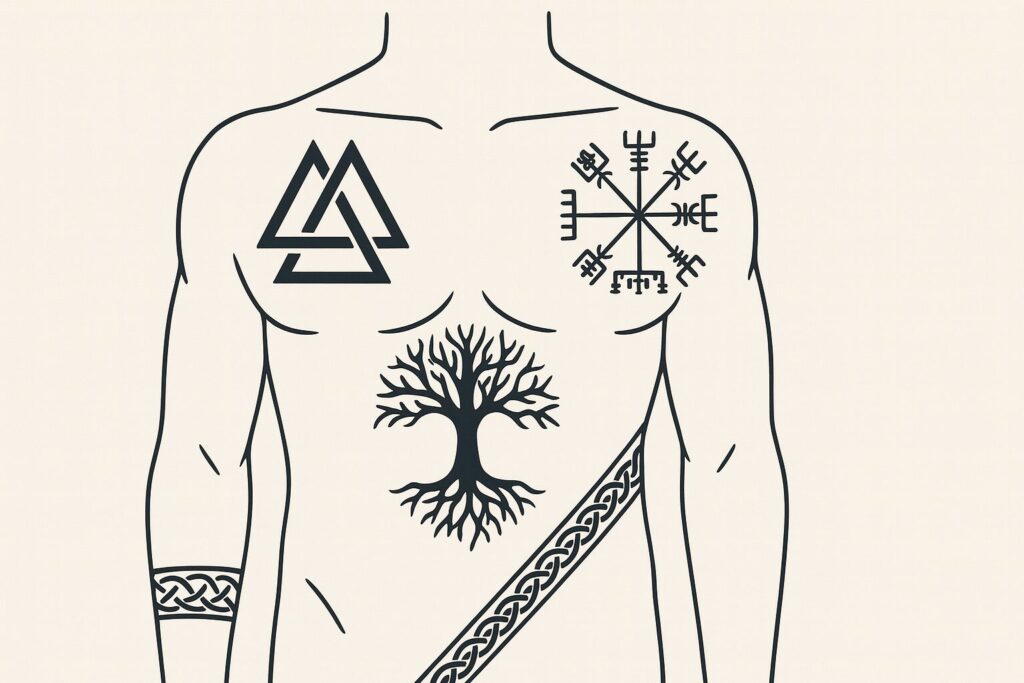
Searches for Norse tattoos for men usually highlight placements like the chest, shoulders, and forearms. These areas work well for larger anchor symbols such as the Valknut, Mjölnir, and Ægishjálmur.
However, because straight lines can warp across soft tissue, chest tattoos look best with a central vertical axis. For example, a spear or the trunk of Yggdrasil provides the eye with a strong centerline.
In addition, calves and shins are great for long vertical motifs. A runic phrase running down the tibia stays crisp, while an axe head on the outer calf flows naturally with the muscle.
Finally, if your job requires more discreet placements, the inner biceps and ribs allow larger Norse tattoo designs while still staying hidden under clothing.
Searches for female Norse tattoos often highlight placements that flow with the body’s movement, such as collarbone arcs, side ribs, the spine, and the outer thigh.
For instance, Yggdrasil works beautifully along the spine because the tree trunk follows the natural line of the body. Likewise, a minimal Vegvísir under the collarbone feels subtle yet still meaningful.
In contrast, a knotwork crescent around the hip creates motion and balance without relying on heavy black fills.
Since comfort matters, thin-line geometry usually suits delicate areas better than dense blackwork.
Nevertheless, you can still add contrast, for example, by placing a bold triangle inside a fine-line frame. Above all, keep negative space intentional so the design has room to breathe and stays visually clear.
Considering a new Valknut tattoo? Safeguard the linework and maintain sharp blacks with this specialized antibacterial soap.
It’s ideal for both in-process and post-tattoo and piercing care. This soap keeps new tattoos clean during the healing phase, helping to reduce irritation and prevent infection.
Perfect for your Tattoo Aftercare Starter Kit.
If your goal is an authentic Norse tattoo, start by choosing one artifact style and build your design from there. For example, the Jelling style is known for ribbon-like animals and knot borders.
In contrast, the Borre style features gripping beasts and dense interlace patterns. Meanwhile, the Urnes style uses sleek, elongated curves that feel more refined.
Therefore, when you talk to your tattoo artist, say something like, “Let’s base this on Urnes curves”, so they can match the line weight and shapes to the original style.
Furthermore, runes require special attention. Each rune represents a sound, not an entire word.
Since online charts often vary, check at least two reliable sources and ask your artist to confirm the spelling. After all, a single mistake can turn “honor” into nonsense.
Careful verification ensures your Norse rune tattoo keeps the meaning you actually want to wear.
Size matters for Norse tattoos, especially if you want them to stay sharp over time.
Tiny micro-lines tend to blur on areas of skin that move a lot, so for long-term clarity, even the smallest Vegvísir should be at least coin-sized, with no ultra-thin strokes.
For medium forearm tattoos, a Valknut inside a simple ring or a Mjölnir silhouette with dot shading works perfectly. Meanwhile, larger back or chest pieces are ideal for Yggdrasil, Viking ships, or a full raven spread.
As a rule, scale the detail to the distance at which people will actually view the design.
Since tattoos age, sun care becomes essential. Always use a high-SPF stick once the tattoo has healed, especially if you spend a lot of time outdoors.
In fact, a bold black Norse tattoo will only stay deep and crisp if you protect it from UV damage.
If you want a Norse tattoo set instead of a single piece, it helps to plan it like a map. To begin with, choose one anchor (such as a chest Valknut) and then echo triangles or rope borders as you add a forearm Mjölnir or a shoulder raven.
This method transforms separate tattoos into a connected story. In addition, repeat one texture style, like stipple shading, across the entire set so the collection feels cohesive and intentional.
Furthermore, runes make excellent connectors between designs. For example, you can place a short motto along the collarbone to link a shoulder raven to a sternum hammer.
Meanwhile, a thin knot band around the wrist can mirror the same weave pattern from the shoulder, tying everything together visually.
Straight lines in Norse tattoos require steady stillness. Therefore, expect your artist to position you carefully and pause for wipes at key corners to keep the geometry clean.
In general, bony areas like the shin or sternum sting more than softer spots such as the outer upper arm. However, the good news is that sessions for geometric Norse tattoos usually finish faster than large, full-color realism pieces.
After the appointment, proper aftercare is crucial. To begin with, wash the tattoo gently, apply a light balm, and avoid direct sun while it heals.
Because scabbing can break crisp lines, always follow the wrap and cleaning schedule your artist recommends.
Later on, keep the tattoo moisturized when the skin feels dry, and schedule a quick touch-up if any corners fade or soften. This approach keeps your Norse tattoo sharp and long-lasting.
Crowding ruins readability in Norse tattoos. For example, if you try to squeeze a hammer, a shield, a raven, runes, and storm clouds into a five-inch space, the result will look muddy and unclear.
Instead, focus on one main symbol and one supporting element. In addition, check for alignment – mirrored lines that don’t match will pull the eye in the wrong way.
Therefore, always inspect the stencil from a few feet away and from multiple angles before the first line goes in.
In the same way, clashing styles weaken a design. A modern geometric Vegvísir paired with cartoon-style clouds looks confused and inconsistent.
As a result, stick with one visual language per tattoo to keep your Norse design strong, clear, and timeless.
When planning a Norse tattoo, start by defining the meaning. Next, choose the symbol that matches your story and pick a style that fits your vision.
After that, select a placement that supports the shape and gather at least two artifact references for accuracy.
In addition, always double-check rune spelling to avoid mistakes. Once that’s done, book an artist with proven clean linework in their portfolio and prepare your aftercare supplies in advance.
As a result, you’ll walk into the appointment calm, make smart choices, and leave with ink that still looks sharp ten years later.
Norse tattoos thrive on clarity. The symbols are bold, the myths are deep, and the lines are built to last. When you choose a symbol with meaning, commit to a style, and scale it to fit the body, your tattoo carries real weight.
For Norse tattoos for men that show presence, anchor the design on the chest or shoulder and keep the geometry tight.
For female Norse tattoos with flow, use the spine, collarbone arcs, or negative space that moves naturally with the body.
At the same time, authentic Norse tattoos stay grounded in references, while smart aftercare keeps them crisp for years.
If you’re browsing Norse tattoo designs for your next session, consider building a small set with repeated borders or textures so each piece connects into one saga.
In short, learn the Norse symbols and meanings, pick the design that speaks to you, and give it the space it deserves.
The result is a Norse tattoo that reads strong from across the room and feels honest and powerful up close.