Physical Address
304 North Cardinal St.
Dorchester Center, MA 02124
Physical Address
304 North Cardinal St.
Dorchester Center, MA 02124

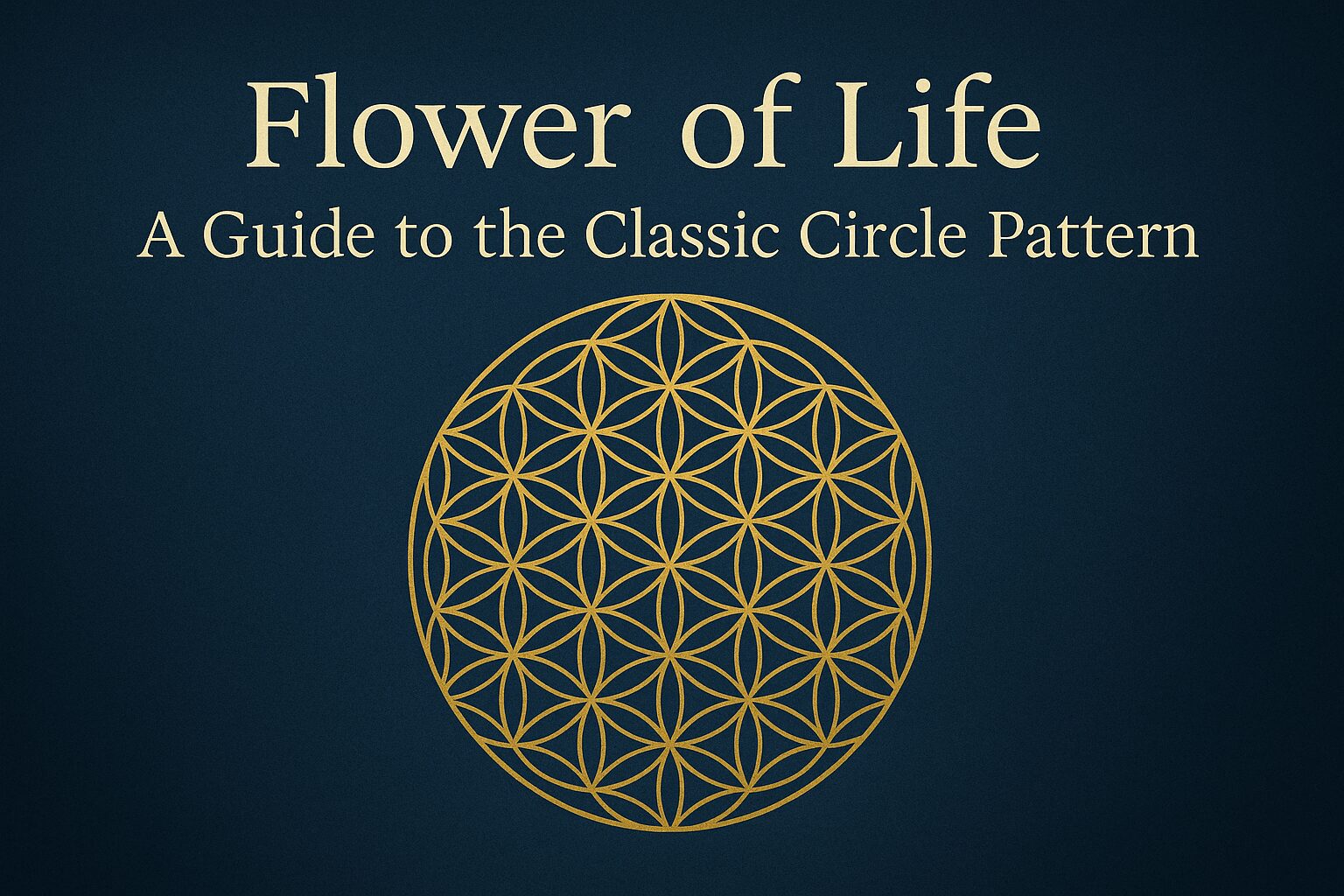
The Flower of Life is a geometric figure composed of multiple overlapping circles arranged in a flower-like pattern. It is considered a symbol of sacred geometry, representing the fundamental forms of space and time. This symbol has been found in various cultures and spiritual traditions around the world.
The flower of life is a repeating circle design that looks simple at first and then, suddenly, it blooms into something hypnotic.
People meet it on jewelry, temple walls, yoga mats, and science-inspired posters, yet the shape isn’t just decorative. It’s a geometric net where each circle touches its neighbors in perfect balance.
As a result, the eye relaxes while the mind starts asking questions. Where did this come from? Why does it feel so familiar? And how can one image carry meaning across cultures and centuries?
Historically, the flower of life appears on ruins in Egypt, in medieval Italian art, and in sacred sites across Asia. Therefore, it’s fair to say the motif travels well.
The design usually begins with one circle, then another of the same size whose center sits on the first circle’s circumference. Gradually, more circles are added in a honeycomb arrangement.
Consequently, petals emerge, which is why it’s called a “flower”.
Although the form is abstract, it suggests seeds, cells, and even star maps. In other words, it mimics the way nature builds complex things from repeating units.
People are drawn to the flower of life because it feels ordered without being rigid. Moreover, the pattern scales endlessly.
You can draw a tiny version on a sticky note or enlarge it across a dome and it still holds together. This flexibility hints at why so many cultures kept it around: it embodies growth, rhythm, and harmony.
Finally, the phrase “flower of life meaning” often circles back to one idea – interconnectedness.
Everything touches everything else through clean, elegant relationships.
Consequently, the symbol functions like a visual mantra, pointing to unity while leaving room for personal interpretation.
When people say “flower of life symbol,” they mean both an image and a carrier of stories. The best symbols do that: they compress history into a small shape.
Similarly, this one links architecture, spirituality, craft, and mathematics. It turns up in the Temple of Osiris at Abydos, on synagogue floors in the Galilee, and in European manuscripts.
Because the construction is purely geometric, it crosses language barriers. Artists didn’t need a common alphabet; they just needed a compass and patience.
However, the symbol’s endurance isn’t only about beauty. Communities kept returning to it for its teaching power.
A monk could point to the interlocking circles and speak about divine order. An artisan could learn proportions and spacing without advanced tools.
Meanwhile, merchants and travelers spread the design along trade routes, so regional versions evolved. Some include borders, others hide stars inside the petals, and a few stack layers into deeper lattices.
Today, the flower of life shows up in graphic design, tattoo art, fashion, and product branding. Consequently, it’s easy to mistake popularity for superficiality.
Yet popularity can also mean accessibility. Because the symbol is easy to draw and recognize, people can enter the conversation quickly.
Moreover, the repeating arcs invite play. You can color it, rotate it, fold it into 3D models, or use it as a grid for other shapes.
Therefore, the “flower of life meaning” isn’t fixed by any single era. It keeps stretching to include new stories while staying anchored to its timeless geometry.
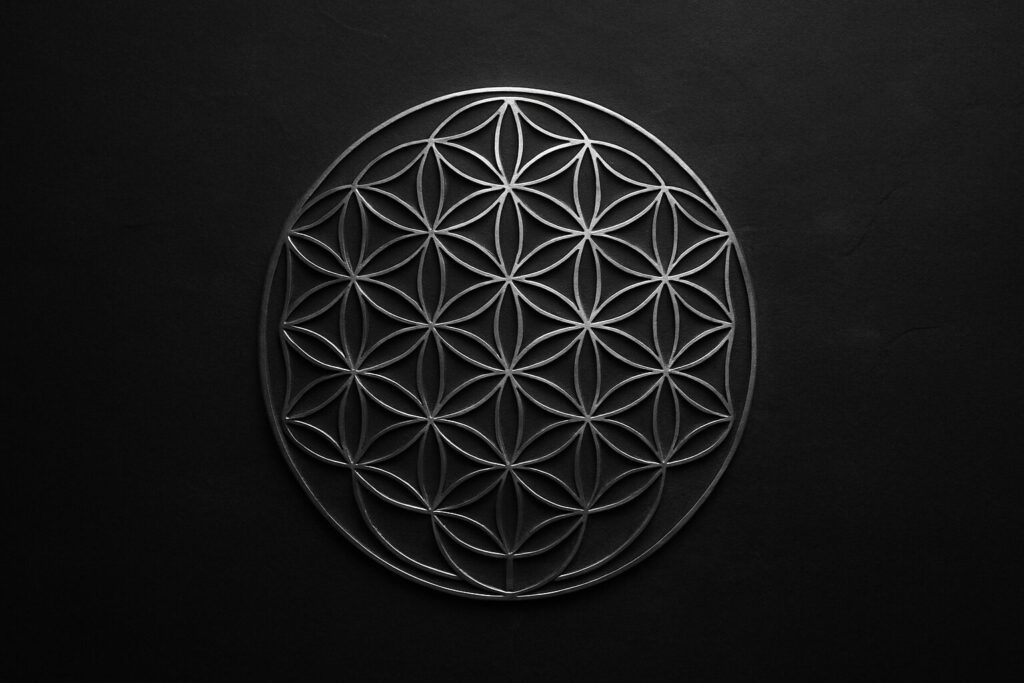
The phrase “flower of life sacred geometry” points to a simple truth: clean geometry feels profound when it mirrors nature. Start with equal circles.
Each circle’s center sits on the edge of another, creating a six-fold symmetry. Consequently, hexagons and triangles appear automatically.
Because the spacing is uniform, the distances repeat in predictable ratios. Therefore, the pattern becomes a lesson in symmetry, proportion, and periodicity.
Moreover, the flower of life works like a visual laboratory.
As you expand the grid, you can highlight the Seed of Life (seven overlapping circles), then the Egg of Life, and even the blueprint for a cube hidden in the lattice.
Although these terms come from different traditions, they describe real, traceable relationships.
Meanwhile, compass-and-straightedge construction keeps the process honest. You aren’t guessing; you’re discovering what emerges when like meets like at equal intervals.
Engineers and designers appreciate the structure because it distributes tension smoothly. However, even without equations, your eyes register the balance.
Lines curve, meet, and mirror each other in ways that feel inevitable.
Additionally, the flower of life pattern hints at packing problems and sphere arrangements – topics that appear in crystallography and materials science.
In other words, the same logic that makes honeycombs efficient shows up here as beauty. Finally, that blend of elegance and utility explains why people keep calling it “sacred”.
The geometry doesn’t preach; it simply reveals rules that already shape the world.
By the way, if you enjoy working with this pattern hands-on, you might love a guided sketchbook that walks you through building it step by step.
Check out this beautifully illustrated Flower of Life journal to practice, reflect, and color as you learn.
The flower of life pattern may look abstract, yet it resonates because living things grow in repeating modules.
Look at the way seeds arrange in a sunflower, or how bubbles cluster when you wash dishes. Although those aren’t perfect copies, the same appetite for efficiency and symmetry is at work.
Consequently, the eye reads the flower of life as “natural”, even when it’s drawn with ink on paper.
In design, the pattern can be both background and blueprint. Architects use its six-fold symmetry for floor tiles, screens, domes, and window grilles.
Moreover, product designers borrow the grid to place elements evenly, which improves balance without drawing attention to the trick.
Musicians even map rhythmic cycles on hexagonal lattices to explore repeating patterns. Meanwhile, in digital art, the lattice doubles as a coordinate system that guides spacing and rotation.
Therefore, the flower of life symbol becomes a practical tool, not just a pretty motif.
At home, you can apply the flower of life in focused ways. Create a coaster, print a wall piece, or sketch a small version before a brainstorming session to set a calm tone.
Additionally, teachers can use the pattern to introduce symmetry and fractions to kids. Because the geometry is friendly, it lowers the fear of math.
However, don’t feel pressured to make it perfect. The tiny human wobble in a hand-drawn arc adds charm.
Finally, the best reason to keep the flower of life nearby is simple: it invites you to slow down, breathe, and notice order where you might otherwise see noise.
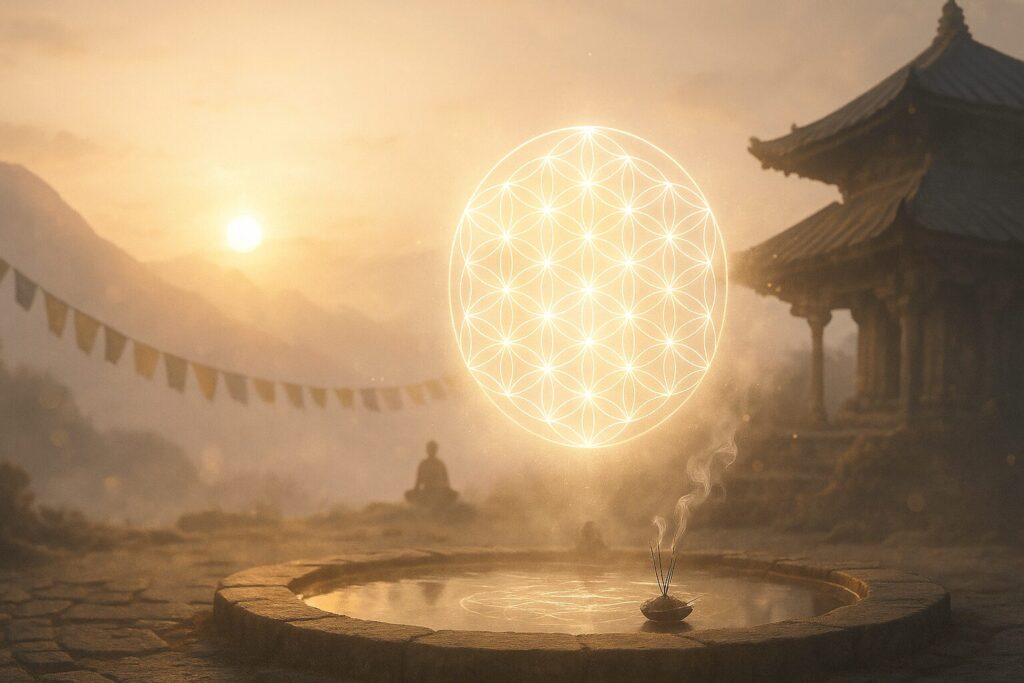
When people search for “flower of life spiritual meaning”, they’re usually after a grounded explanation rather than lofty claims.
Start with what you can experience directly. If you trace the arcs slowly, your breath naturally evens out. Because the pattern is repetitive, your attention settles without force.
Therefore, it can function as a meditation aid. Moreover, the petals suggest unfolding, which many people link to personal growth and renewal.
Different traditions read the symbol through their own lenses. Some see a map of creation, where a single point expands into multiplicity while staying connected.
Others focus on the interlocking circles as a reminder that boundaries can meet without conflict. Consequently, the flower of life meaning often feels inclusive: it welcomes diverse beliefs while pointing toward unity.
However, staying respectful of cultural contexts matters. The same image on a temple wall and on a coffee mug carries different weight. A little humility goes a long way.
Practically speaking, you can use the pattern to frame journaling prompts, set intentions, or close a yoga session.
Additionally, some people visualize the lattice during breathwork to maintain gentle focus. Although results vary, many report a calmer mood and steadier attention.
Meanwhile, skeptics can appreciate the cognitive benefits of rhythmic drawing and symmetrical visuals without adopting any metaphysical claims.
In other words, the flower of life offers a spectrum of uses, from spiritual symbol to wellness tool to pure art.
Finally, because it’s easy to learn and teach, the practice tends to spread through communities in a friendly, hands-on way.
If you want to connect with the flower of life, drawing it is the best teacher. Start with a small circle. Place the compass point on the circle’s edge and draw another of the same size.
Additionally, continue stepping the compass around the original center to complete six surrounding circles. Consequently, you’ll see a rosette – often called the Seed of Life.
Then, extend outward by repeating the process at new intersection points. Because the distances never change, the petals knit together cleanly.
Moreover, the act of drawing reveals tiny lessons about proportion and patience. You’ll notice how subtle shifts affect the entire pattern.
Therefore, it helps to slow down, breathe, and keep the pencil light at first. However, don’t chase perfection like a machine. The gentle inconsistencies of a handmade flower of life pattern make it yours.
Meanwhile, coloring the petals in alternating tones highlights hidden triangles and hexagons, which deepens your understanding without extra math.
To keep exploring, photograph your drawing and overlay translucent layers on a tablet. Additionally, try building a grid in vector software and place icons or letters on the intersections to test layout ideas.
Because the framework is versatile, you can repurpose it for logos, posters, quilting, or even garden plans. Finally, remember that the flower of life symbol is less about answers and more about processes.
Each pass teaches you to observe, adjust, and continue. Consequently, the “flower of life meaning” grows with you.
It becomes a daily reminder that clarity often emerges from simple, repeated steps aligned with steady attention.