Physical Address
304 North Cardinal St.
Dorchester Center, MA 02124
Physical Address
304 North Cardinal St.
Dorchester Center, MA 02124

So, Celtic knots look pretty simple at first, but when you start actually following the lines, they just keep looping forever.
That endless flow is what makes them feel kind of alive. What I’m gonna do here is break down what these knots actually are, where they originally came from, and how people still use them today.
And don’t worry, I’ll keep it simple – short parts, clear explanations, no fancy confusing words. By the time you finish reading, you’ll understand the meaning, the stories, and the history behind them.
Celtic knots use lines that weave over and under in a loop that never ends.
You can find them carved into stone crosses in Ireland and Scotland, or painted inside the Book of Kells, one of the most famous manuscripts from that time.
The flow of the design is always the same. A line moves ahead, slips beneath, rises again, and keeps going.
Because there’s never a break or a loose end, the whole knot feels alive, carrying the meaning that comes from its unbroken circle.
Searching for the meaning of a Celtic knot doesn’t lead to one fixed answer. There’s no official definition. The knot is more like a visual metaphor, and its meaning depends on the context where it appears.
Even so, certain themes come up again and again: eternity, unity, and the cycle of life. The endless loop speaks to continuity.
The way the lines weave over and under creates a steady flow, almost like breathing in and out. It gives the design a feeling of harmony and balance.
In the Middle Ages, monks used these endless knots to frame pages of the Bible, so the never-ending line became a symbol that the words inside were eternal.
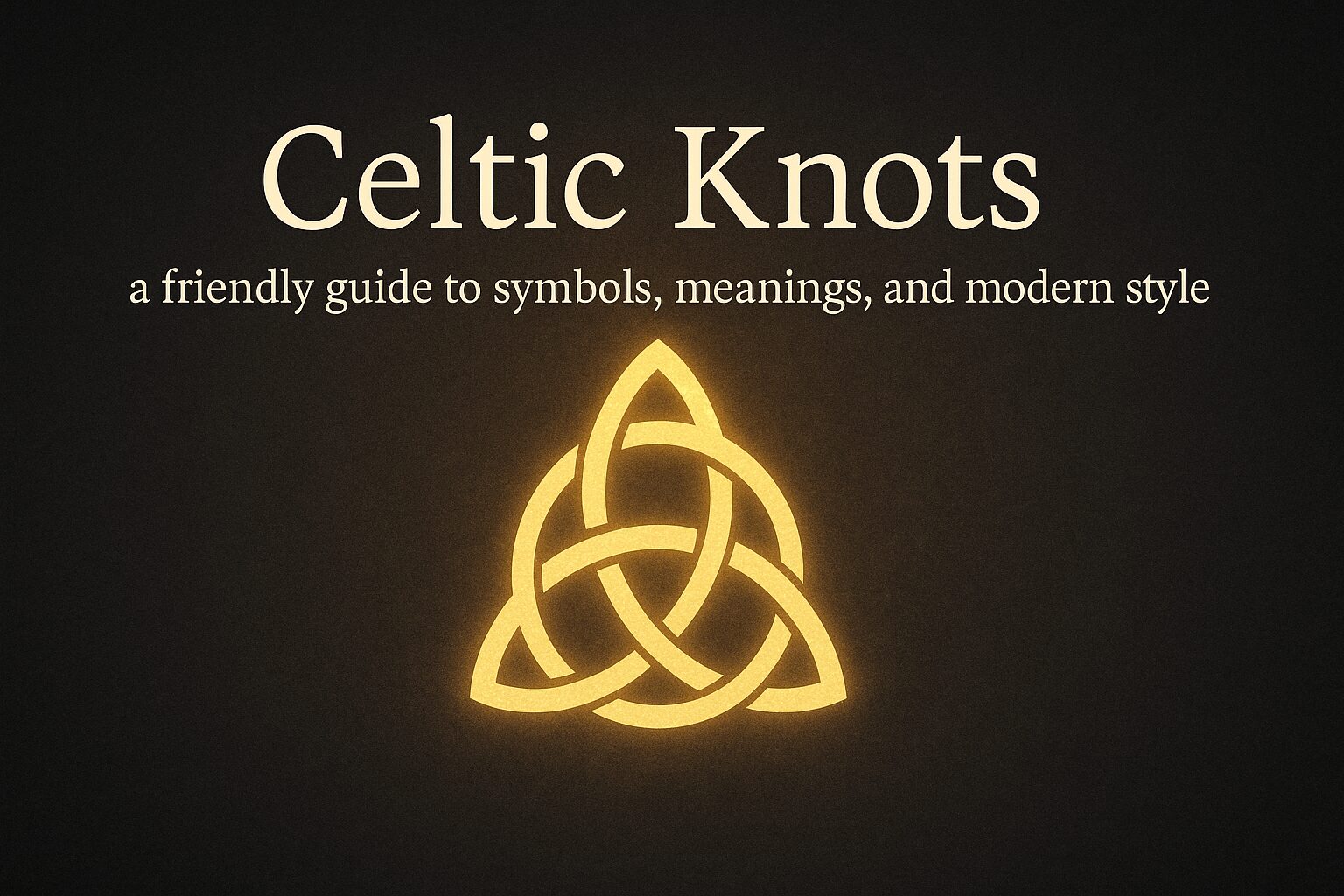
The triquetra is probably the most famous Celtic knot. It’s made from one continuous line that loops to form three connected points. In Christian art, it was often used to represent the Holy Trinity.
In older Celtic traditions and in modern paganism, the same shape can stand for earth, sea, and sky – or for the three stages of life: maiden, mother, and crone.
Because the design has three parts joined by a single line, it’s all about unity. It shows how separate things can still be connected as one.
That’s why the triquetra is often chosen to symbolize faith, nature, or even family – anything where three distinct elements come together into a whole.
The Celtic love knot is made of two lines woven together in a single, unbroken loop. In weddings, it represents two lives joined as one, with the endless path showing lasting commitment.
That’s why the love knot is often used on rings, pendants, and other jewelry – keeping the meaning close to the heart.
Outside of weddings, the love knot still works as a symbol of loyalty and devotion. It says “forever” without needing any words, which is why it’s such a popular choice for anniversaries and engagements.
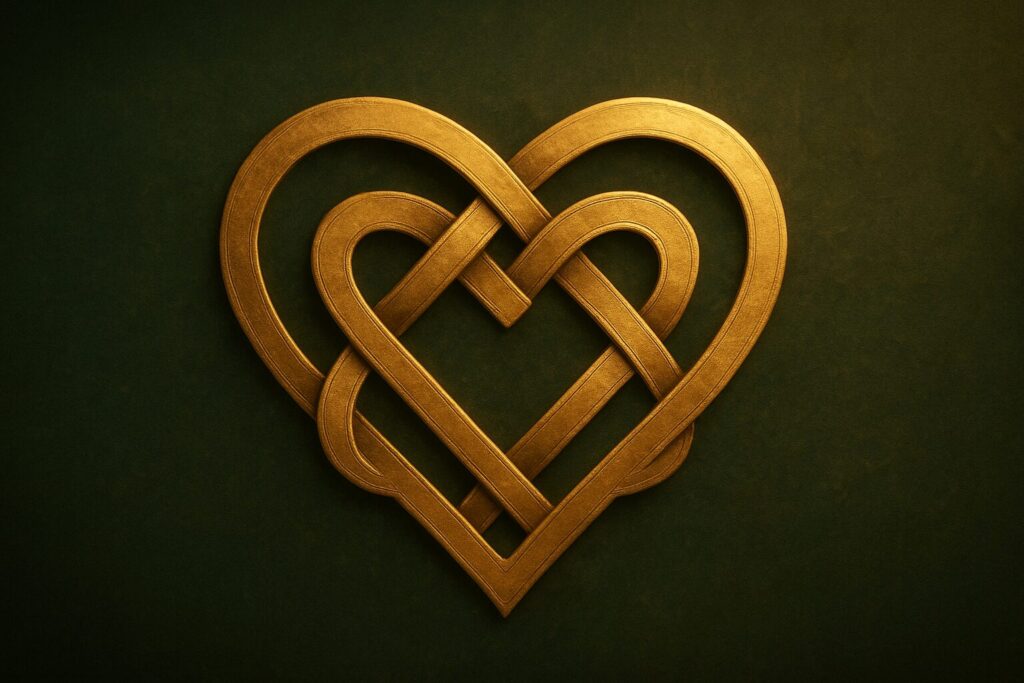
The meaning of Celtic knots comes from their structure. Since the line never ends, the design naturally represents things that last – like loyalty, memory, faith, and heritage.
That’s why people use knots to mark important milestones. For example, a baptism card decorated with knotwork connects a new beginning to the idea of something everlasting.
The weaving pattern also adds another layer of meaning. The way the line rises and dips is like the ups and downs of life, but the path never stops.
That’s the reason Celtic knots still feel powerful and relevant today.
Knotwork exists in many cultures, but the style we now think of as Celtic knots took shape in early medieval Ireland and Britain.
Craftsmen carved the patterns into stone crosses, painted them into illuminated manuscripts, and later wove them into fabrics.
When Irish communities spread across the world, they brought the designs with them.
That’s why you can spot Celtic knots today on pub signs in Boston, tattoos in Sydney, and wedding rings in Dublin.
Even though the tradition is ancient, the designs still evolve.
Modern artists often blend the classic loops with sleek, minimal lines, making them fit naturally into today’s homes, fashion, and jewelry.
Not every Celtic knot carries the same meaning, but you can usually figure it out by looking at a few details.
Start with the strands. One strand can suggest an individual path or journey. Two strands often stand for partnership. Three strands point to a triad, whether spiritual or symbolic.
The frame also matters. A circle gives the design an eternal, cosmic feel, while a square makes it feel more grounded and stable.
Extra symbols can shift the message too – for instance, a love knot shaped into a heart clearly leans toward romance.
Since the message is built into the design itself, you don’t need a long explanation. A quick glance is often enough to see what the knot is meant to say.
One of the best ways to really understand Celtic knots is to draw one yourself. Start with a grid of evenly spaced dots. Sketch a line that moves diagonally, weaving over and under at each crossing.
Then double the line to form a band, round off the corners, and erase the extra marks.
Doing it by hand helps you see how the pattern works, so the symbolism makes more sense.
Plus, you’ll have a design of your own that you can frame, print on a card, or share with a friend.
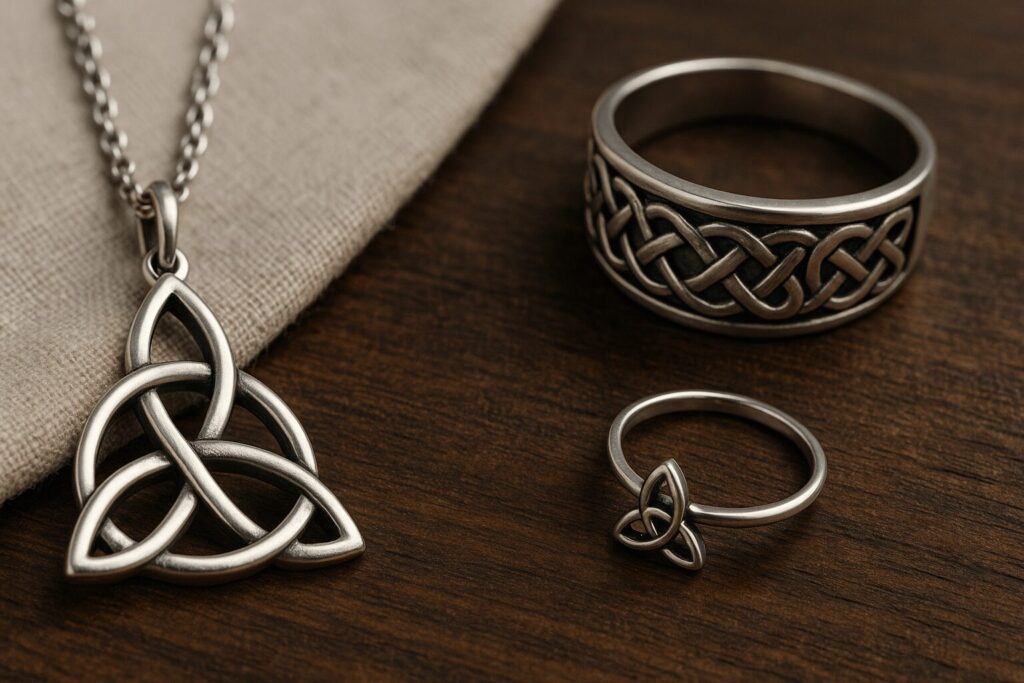
When choosing Celtic knot jewelry, start with the meaning you want it to carry. A triquetra pendant works well as a symbol of faith. A love knot ring is the perfect choice for romance.
The material changes the look too. Sterling silver gives a sharp, clean contrast. Yellow gold adds warmth. Stainless steel is tough enough for everyday wear.
Depth also matters – a raised design makes the weaving pattern stand out, especially on smaller pieces like earrings.
Size plays a role as well. Bold, detailed knots work best on pendants, while simpler designs fit better on narrow bands. Matching the knot style to the jewelry makes the meaning and design stand out clearly.
Shop curated Celtic knot jewelry →
Size matters too. A large, detailed knot works beautifully on a pendant, while a simpler design looks better on a narrow ring band. The key is to match the complexity of the knot to the piece of jewelry.
There are a few common myths about Celtic knots, so let’s set the record straight. One myth is that every knot has a single “official” meaning. In reality, artists used the same patterns in different ways.
The best way to understand the meaning is to look at the context. A triquetra in a church window probably points to the Holy Trinity, while the same shape in a modern tattoo might represent a personal story with three parts.
Another myth is that Celtic knots are thousands of years older than they really are. The designs we recognize today actually developed in the early medieval period.
So when you choose a Celtic knot, you’re connecting to a tradition that’s ancient but also shaped by centuries of creative evolution.
Celtic knot designs work in more places than you might expect. A set of coasters with a knot border can bring a touch of heritage into the kitchen.
A small triquetra charm on a bracelet can quietly symbolize faith or family. And a piece of wall art with a wide looping knot can give a room a sense of balance and focus.
Since the patterns are geometric, they fit easily into modern decor. You can keep a clean, minimal look while still showing off culture and story.
Here’s a quick recap. Celtic knots are looping patterns with no beginning or end, rooted in Celtic art. The meanings people connect to them usually center on eternity, unity, and the cycle of life.
The triquetra, with its three points, represents triple concepts – like the Trinity, or earth, sea, and sky. The love knot uses two strands to symbolize partnership and lasting bonds.
And today, these designs show up everywhere from rings and pendants to bracelets and earrings.
Because language can get fuzzy online, this recap keeps your mental map clean.
The more you study Celtic knots, the more their meaning comes through. The never-ending line explains why they symbolize continuity and connection.
Specific designs, like the triquetra or the love knot, give you simple ways to express faith, nature, or relationships.
If you came here looking for jewelry, you now know how to pick a design that matches the message you want to share.
If you were curious about their meaning, you’ve seen how structure and placement tell the story. And if you just enjoy the art, you can now recognize the logic behind the loops.
In the end, Celtic knots last because the line never stops – and every time your eyes follow the pattern, the story feels new again.