Physical Address
304 North Cardinal St.
Dorchester Center, MA 02124
Physical Address
304 North Cardinal St.
Dorchester Center, MA 02124

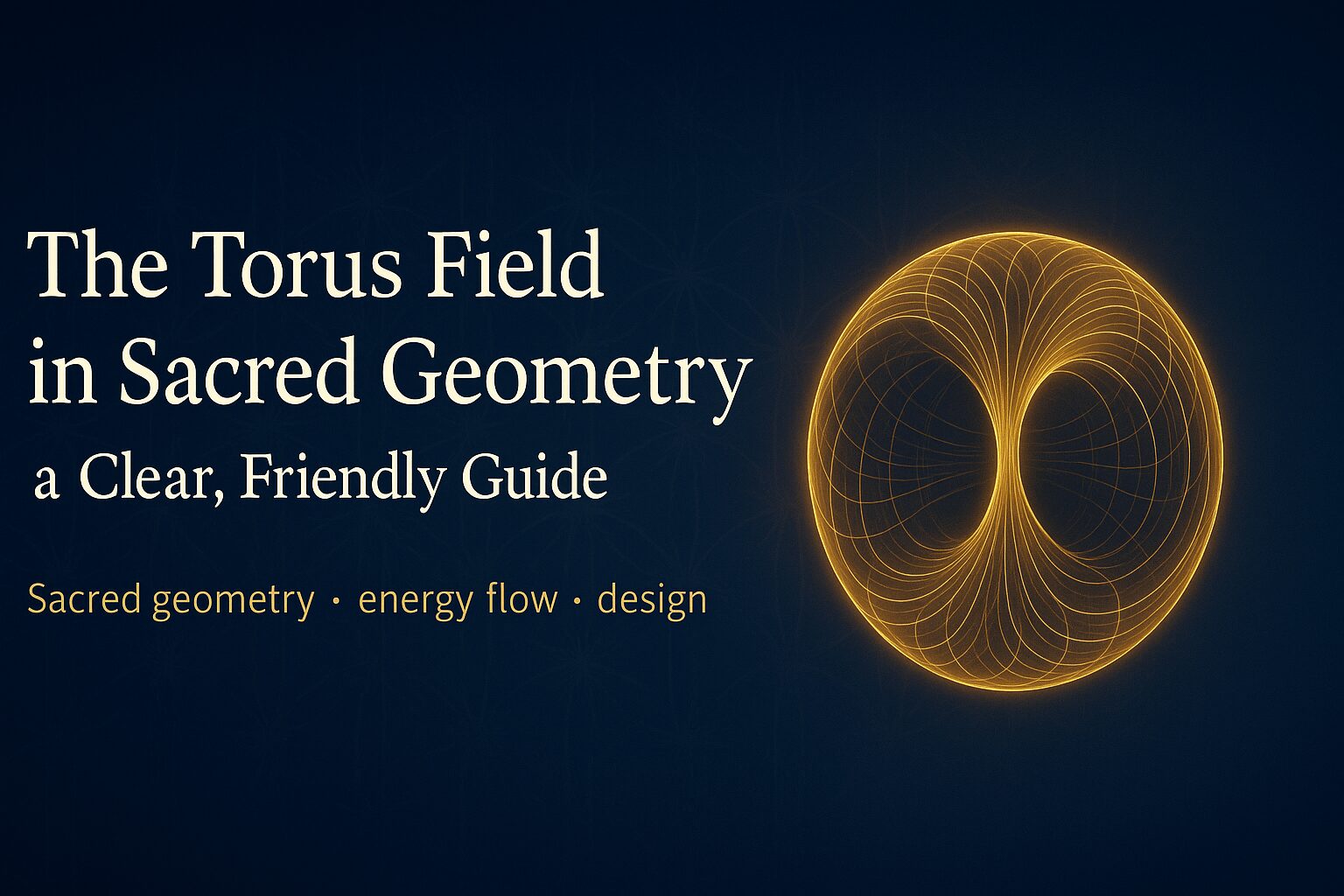
A Torus field is a concept that describes a specific type of energy field shaped like a torus, which is a doughnut-shaped geometric figure. This concept is often discussed in various fields, including physics, metaphysics, and spirituality.
In sacred geometry, the Torus field shows the living picture of energy flow. Imagine a breath that never ends: energy rises through a central channel, curves across the surface, returns through the center, and begins again.
Because the loop never breaks, the Torus shape teaches balance, exchange, and renewal all at once.
Next, we’ll explore how the Torus field meaning appears in classic sacred geometry patterns and why artists use it to guide focus in design and meditation.
In addition, we’ll look at how the language of magnetism echoes the same form, giving you a bridge between science and symbolism.
Finally, you’ll see practical visuals and simple exercises you can try in your own space to understand the Torus not as an abstract idea, but as something you can draw, build, and feel.
When we talk about the Torus field in sacred geometry, we mean a continuous circulation mapped onto a torus – the donut-shaped surface formed when a circle spins around an axis.
Energy flows inward along the central axis (the “spine”), spreads outward across the ring, and then folds back into its source.
Because the loop closes, the Torus shape reads as a self-sustaining, self-feeding system.
In sacred geometry, that return matters most. The eye naturally follows the loop and settles into calm focus.
As a result, the Torus field meaning works beautifully in mandalas, altar arrangements, and even page layouts where the goal is centered attention and balance.
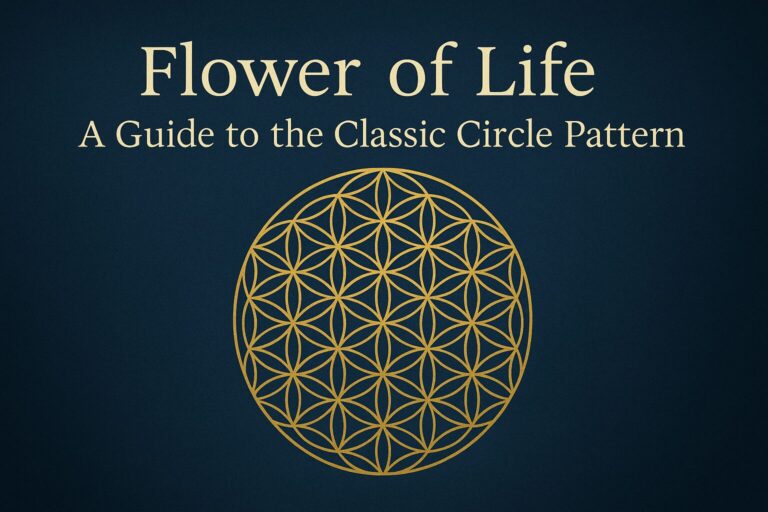
Start with the Seed of Life: six circles arranged around a central one. As you expand that pattern into the Flower of Life, the overlapping arcs suggest both depth and a central well.
When you shade those paths, a toroidal cross-section appears. For this reason, many artists describe the Flower of Life as the “flat blueprint” and the Torus field as the “inflated form”.
If you rotate that cross-section around its central axis, the full torus shape emerges.
The circulation implied in the Flower of Life now becomes clear: energy moves into the center, arcs over the surface, and folds back inward.
In other words, the Flower of Life and the Torus field reflect the same principle – one expressed in a flat design, the other in three-dimensional space.
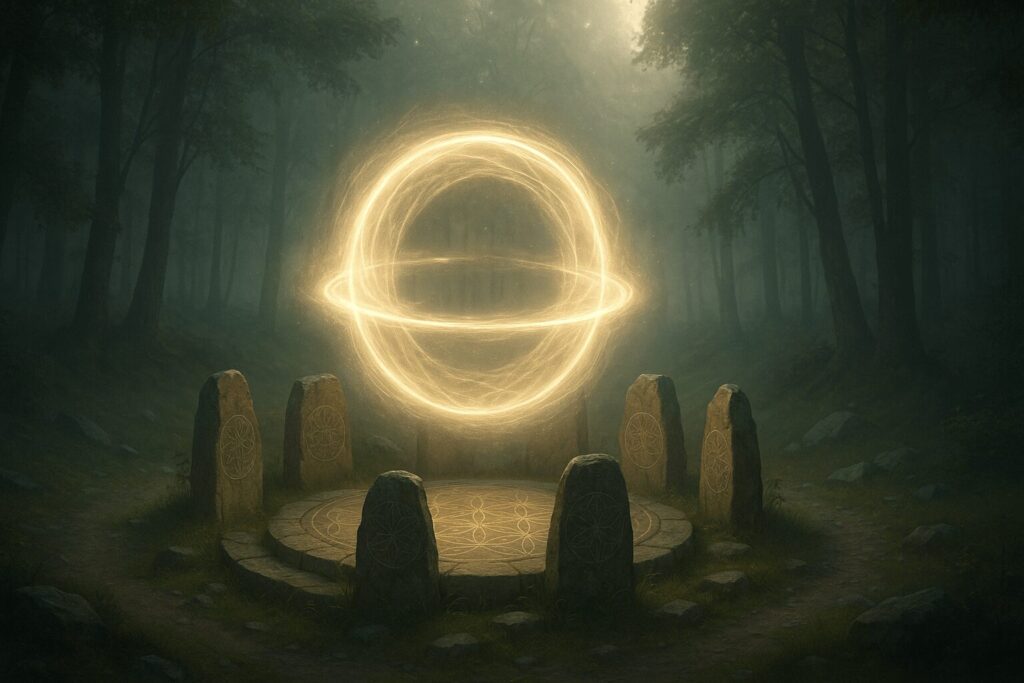
In sacred geometry, teachers often describe a Torus energy field surrounding the body.
The image is simple: you inhale through the center line, let energy radiate outward along the skin, and then exhale back into the center.
Because the loop never breaks, the practice works as visualization, breathwork, or even movement, training both rhythm and presence.
In design and performance, creators borrow the same Torus field meaning for posture and stagecraft.
You place the focal point at the heart (the center of the torus) then arrange secondary elements along the outer ring. As a result, attention flows smoothly along the curve, guiding the audience without effort.
Even though this guide speaks from a sacred geometry lens, the language of physics gives useful anchors.
In electronics, a toroidal inductor pushes current through a ring, generating an electromagnetic Torus field that mostly stays contained inside the loop.
Because of its design, the form holds energy tightly and reduces leakage.
In physics classes, when you hear about a Torus magnetic field, you usually see nested loops: energy leaves a pole, arcs outward, and then circles back in.
The sacred diagram mirrors that same motion. This doesn’t mean meditation turns into an experiment – it just gives your imagination a clear reference.
So when you visualize the Torus field meaning in practice, you’re working with a geometry that real magnetic fields also favor.
Start with a vertical line to mark the center. Then sketch a circle that touches this line at the top and bottom.
Next, draw arrows that move downward along the center line, curl outward at the base, sweep around the outer ring, and rise back up the line.
Keep repeating those arrows around the circle until the Torus energy flow looks alive and continuous.
After that, add a second, thinner loop to show a softer return current. Place small tick marks along the surface so they curve with the shape.
As a result, the Torus diagram shows depth and direction without needing heavy shading.
The eye naturally looks for closure, and a loop delivers it. The Torus field meaning satisfies that need while still leaving room for movement.
You notice the center, yet you don’t get stuck there. Instead, your attention follows the arc, circles back, and breathes again.
In design, this principle works beautifully. Place the headline near the inner well to anchor focus. Then float key images along the outer ring so the viewer’s eye keeps moving.
Finally, land the call-to-action close to the center again. Because the loop closes, the entire layout feels natural and inevitable.
Artists in many fields turn to the Torus field meaning for inspiration. Ceramicists shape torus-like rings to frame vessels.
Jewelers set stones along a toroidal path so light appears to circulate. Tattoo artists trace torus outlines on the sternum to highlight breath and balance.
Meanwhile, motion designers animate particles streaming through a torus to symbolize renewal and regeneration.
If you practice ritual arts, you can apply the same idea at home. Start with a circular cloth as your altar. Place a candle in the center to mark the axial well.
Then arrange objects along the outer ring to represent qualities you want to radiate – clarity, patience, courage – and let them visually cycle back toward the flame.
Because the setup echoes the natural flow of the Torus, the altar feels alive and complete.
Online you’ll see the phrases Torus energy field, electromagnetic Torus field, and Torus magnetic field used interchangeably. Keep the frame explicit in your sentences.
If you mean meditation and visualization, say “energy field”. If you mean coils and currents, say “electromagnetic”. If you mean magnetic shape in general, say “magnetic field”.
Because readers come from mixed backgrounds, clear labels prevent confusion and build trust.
Try this simple two-minute Torus field meditation. Sit tall and steady. As you inhale, picture your breath rising through the inner channel of your Torus field.
When the inhale reaches the top, imagine the breath arcing over your shoulders. As you exhale, sense the flow traveling down the outer ring and returning to your belly.
Pause briefly at the base before starting the next round. Continue for six cycles.
In this way, sacred geometry turns into choreography. You’re not just looking at a diagram – you’re tracing the Torus field with your breath.
Therefore, the symbol becomes a living pattern you can feel, not just an image hanging on a wall.
Is the Torus field real or symbolic?
In sacred geometry, practitioners use the Torus as a teaching symbol for balance, rhythm, and circulation.
In scientific contexts, engineers and physicists construct devices such as toroidal inductors and plasma confinement systems that employ the same shape to manage energy flow.
Therefore, both the metaphor and the machine share a common geometry of inward and outward circulation.
Does the Torus connect to the golden ratio?
Some artists overlay Phi spirals onto the Torus field to highlight focal points. This alignment is aesthetic rather than mathematically strict.
However, the pairing works because both the Phi spiral and the Torus promise continuous growth, smooth movement, and graceful return.
Can you blend the Torus with the Flower of Life in one image?
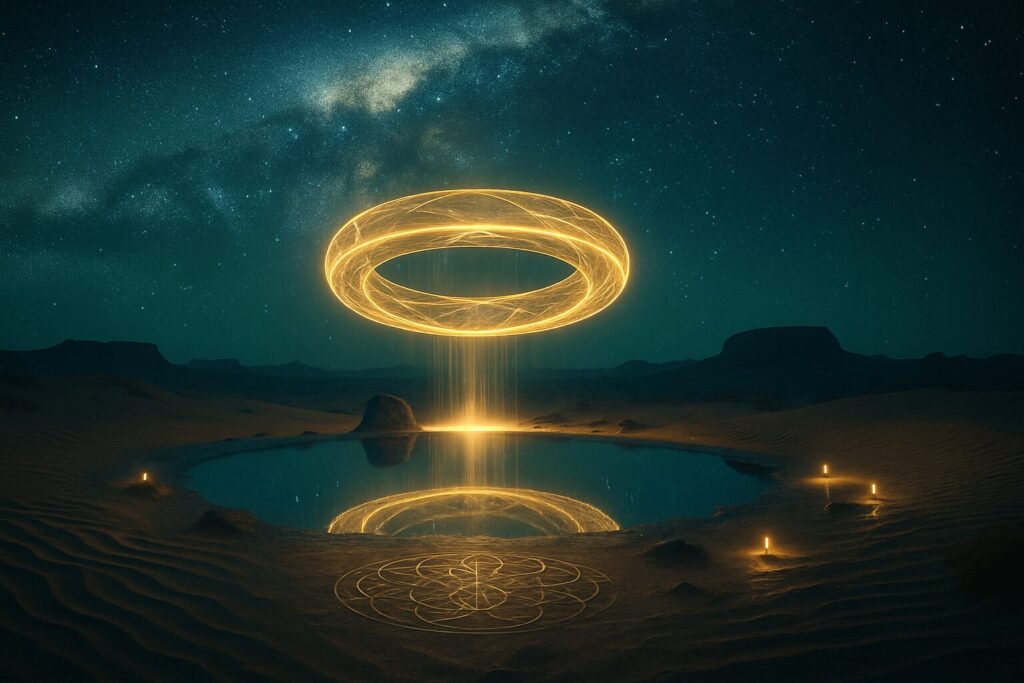
Yes. When you draw the Flower of Life as a geometric grid and then place a shaded Torus above it, the Flower provides harmonic structure while the Torus adds dynamic motion.
Consequently, the composition feels both stable and alive, combining symmetry with flow.
The Torus field gives sacred geometry a strong backbone that you can apply in drawing, meditation, and design. Its continuous loop teaches reciprocity, centers your attention, and keeps movement alive.
Moreover, the Torus bridges different worlds (artistic, contemplative, and scientific) through one universal form.
The geometry itself stays simple, yet the applications stretch wide.
Therefore, use the Torus field whenever you want calm clarity, steady flow, and the grounding sense of always returning to center, again and again, just like breath done right.