Physical Address
304 North Cardinal St.
Dorchester Center, MA 02124
Physical Address
304 North Cardinal St.
Dorchester Center, MA 02124

An octahedron is a three-dimensional geometric shape that is classified as one of the five Platonic solids. It is characterized by its eight triangular faces, twelve edges, and six vertices.
The Octahedron is one of the cleanest shapes in sacred geometry. Imagine two pyramids joined at their base – balanced, sharp, and symmetrical from every angle.
In spiritual practice, the it often connects with the element of Air, symbolizing breath, thought, and clarity of mind.
Because of that, it works as a grounding symbol for focus, calm decision-making, and mental balance without losing energy.
The Octahedron is a Platonic solid made of eight equilateral-triangle faces, twelve edges, and six vertices. Its perfect symmetry puts balance at the center of its design.
Because the shape mirrors itself through the middle, the Octahedron meaning often comes through as “alignment” or “as above, so below”.
When you hold it, the symmetry feels like a steady spine. The vertical axis naturally encourages slow, deep breaths, while the horizontal “equator” opens a sense of space.
For that reason, the Octahedron works well as a focus tool before planning, writing, or facing hard conversations.
In many modern sacred geometry systems, the Octahedron meaning connects to the element of Air. That link makes sense – the shape feels light, precise, and evenly balanced.
Because of that, people use it as a symbol for clear speech, fair judgment, and mental clarity.
Think of the Octahedron as a reminder of balanced exchange: you inhale, you exhale; you speak, you listen.
With its mirrored faces, the form encourages equal give-and-take and steadies the mind in moments that demand focus.
Search for Octahedron Tetrahedron meaning and you’ll see why these two show up together so often.
They’re geometric duals: every vertex of the Octahedron aligns with the center of a Tetrahedron’s face, and vice versa. If you place a Tetrahedron inside an Octahedron, the points lock neatly into the triangular centers.
That connection isn’t just math – it’s practice. Picture a small Tetrahedron spinning inside its larger Octahedron shell.
As you inhale, feel the spacious outer frame expand. As you exhale, sense the Tetrahedron sharpening into focus.
This rhythm moves you between open awareness and precise action, giving you balance instead of drift.
Search for Cube Octahedron meaning and you’ll run into two separate ideas. First, the cube and the octahedron are geometric duals.
Place a cube inside an octahedron and each cube corner touches the center of a triangular face; flip the setup, and the relationship still holds.
Because of that mirroring, many artists pair the cube with the octahedron to balance Earth (cube) with Air (octa).
Second, you’ll also find the cuboctahedron, sometimes written “cube-octahedron”. That solid mixes both square and triangular faces, but it isn’t a Platonic solid and it isn’t the focus here.
Instead, treat it as a bridge shape that conceptually sits between the cube and the octahedron. For sacred geometry practice and symbolic use, keep your attention on the true pair: cube plus octahedron.
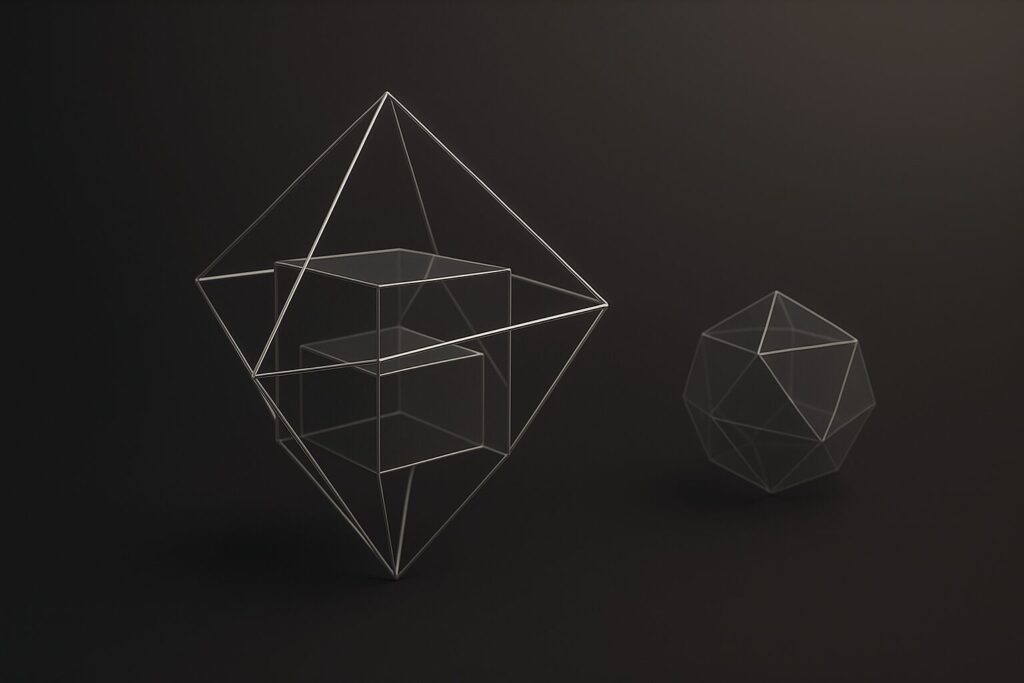
A stellated Octahedron extends the triangular faces outward into sharp points. The classic form, known as the stella octangula, looks like two interlocking tetrahedra sharing a single center.
In sacred geometry practice, many call this shape the star tetrahedron or Merkaba. Even with the new star-like edges, the figure still expresses the same symmetry and balance as the core octahedron.
Think of it as clarity with boundaries. The inner octahedron forms a calm “air chamber”, while the outer star points define your edges.
This visualization helps you balance soft presence with firm structure – open within, steady without.
Understanding the symbol meaning clicks when you build it with your hands. Print a paper net, cut it out, fold along the lines, and glue the faces.
Since all sides are equilateral triangles, the solid locks into shape quickly. Keep the model on your desk and spin it whenever your focus slips.
Drawing an octahedron is just as straightforward. Begin with a diamond shape (a square rotated 45°). Sketch a second, slightly offset diamond behind it.
Connect the matching corners, erase the hidden lines, and shade a few faces to give it depth. With just a few strokes, the form pops into 3D and your mind locks onto its clean structure.
Want a hands-on set that includes a regular Octahedron you can hold? This five-piece Platonic Solids crystal kit (labeled, palm-size) is perfect for desk focus or altar work: Platonic Solids Set.
Sit or stand with your spine straight and picture a small octahedron symbol glowing at your solar plexus. Inhale for four counts and imagine the horizontal “equator” expanding outward like wings.
Exhale for six counts and feel the top and bottom points stretching along your spine. Repeat this rhythm for ten breaths. The steady count keeps your mind quiet without strain.
When you finish, write down one line naming your next action. Add a quick sketch of an octahedron beside it as a visual tag.
Later, that symbol cues your memory and reconnects you with the calm focus you built in practice.
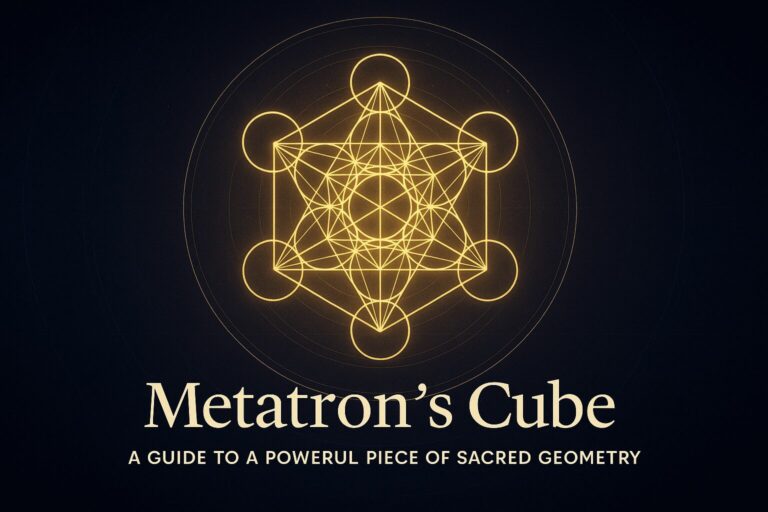
If you already work with Metatron’s Cube, the octahedron shape sits right inside it. Connect the right points in the 13-circle grid and the eight-faced solid appears.
Crystal-grid practitioners often place clear or light stones at the octahedron corners to highlight mental clarity instead of heaviness.
For everyday use, hang a simple octahedron print above your desk to set the tone quickly. Pair it with a cube on a shelf to send a clear message: think with clarity, then act with steadiness.
Small visual cues like these help daily habits stick.
Reach for the tetrahedron when you need decisive momentum. Choose the octahedron when you want balanced perspective and calm clarity.
Pair the cube and octahedron together when you need grounding – perfect before a performance review or a big decision.
On days when you need stronger boundaries in public spaces, work with the stellated octahedron (or star tetrahedron) to hold your edges.
Since each sacred geometry shape shifts your focus in a different way, rotating them through your week keeps your practice fresh and effective.
One common mistake with the octahedron is flattening it into a simple diamond logo and stopping there. A logo is just a projection; the real power comes from the full 3D form you can hold and rotate.
Build or buy a physical model if you want the octahedron meaning to land fully.
Another mix-up happens with the term cube octahedron. The true Platonic solid has only triangular faces. If your diagram includes both triangles and squares, you’re looking at a cuboctahedron instead.
Label it correctly and your symbolism stays sharp.
Finally, don’t jump straight into stellated or “star” forms. Sit with the regular octahedron shape first.
Once a simple breath practice with it actually calms your mind, the star tetrahedron will feel like a natural next step instead of just another flashy distraction.
Is the Octahedron always linked to Air?
Most traditions connect the Octahedron meaning to the element of Air – thought, breath, and balance. Some systems differ, but the key is choosing one mapping and staying consistent.
Octahedron–Tetrahedron meditations
In Octahedron meditation, the outer shell represents wide awareness while the inner tetrahedron represents decisive action. Shifting between them helps you balance reflection with momentum.
Quick practice
Hold a palm-sized Octahedron shape, take ten steady breaths, and write down your next step. Simple enough to use daily.
Bringing it together
The Octahedron offers clarity, balance, and focus. Whether in meditation, visualization, or as a desk totem, it helps steady the mind while keeping your purpose sharp.
The Octahedron is sacred geometry at its most steady – symmetrical, precise, and practical. This Octahedron shape clears the mind, steadies the breath, and frames choices with calm focus.
When you grasp the Octahedron–Tetrahedron duality, the grounding link to the cube, and the boundary-setting feel of the stellated form, you end up with a toolkit you can use anytime.
So build one. Sketch one. Try a short Octahedron meditation. Place the solid where decisions happen – on your desk, near a doorway, or inside a Metatron’s Cube grid.
Because the geometry is honest and balanced, your day starts to echo it. That’s the quiet strength of the Octahedron: simple lines, a clear head, and action that lands exactly where you aim.