Physical Address
304 North Cardinal St.
Dorchester Center, MA 02124
Physical Address
304 North Cardinal St.
Dorchester Center, MA 02124

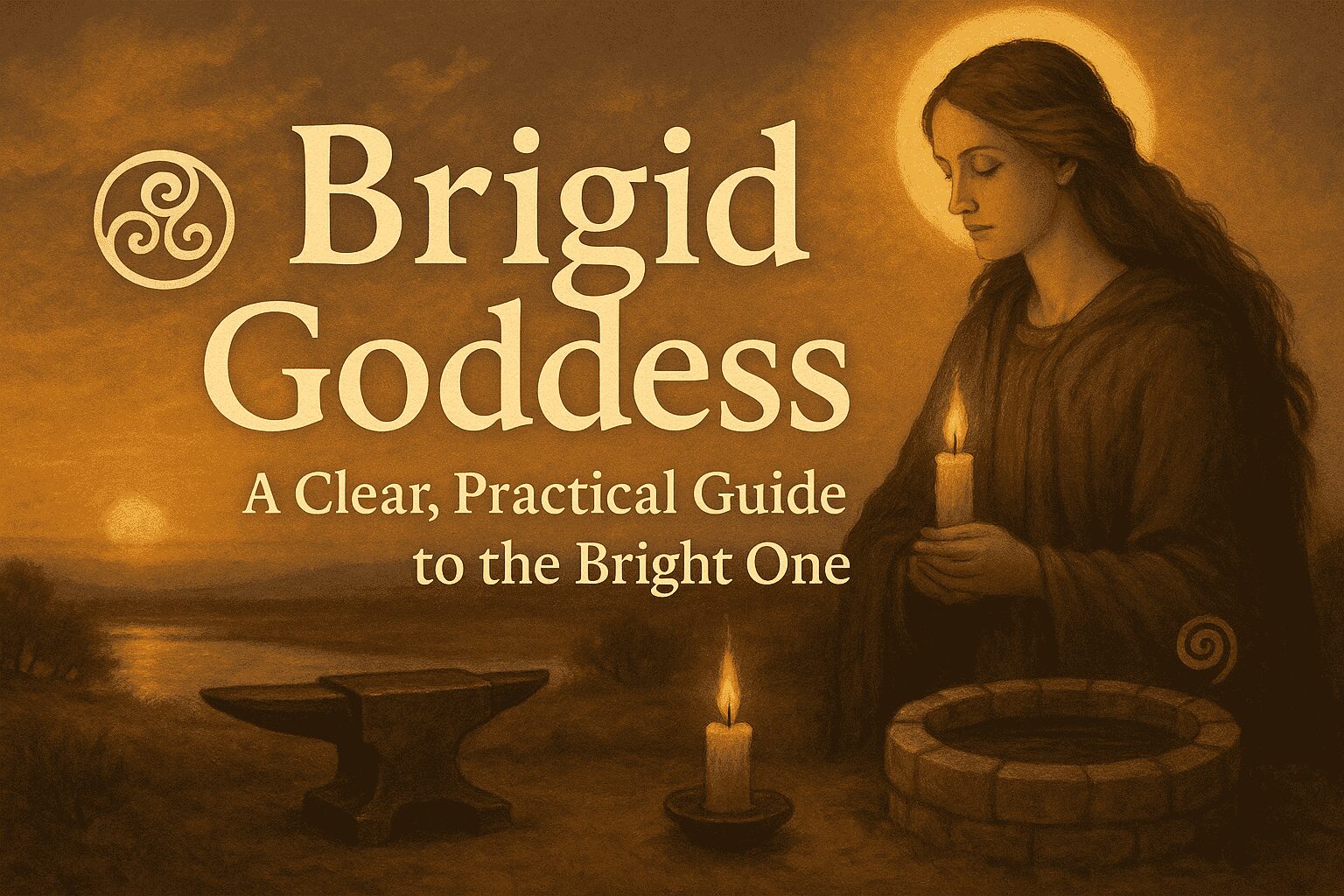
Brigid goddess – central to Celtic myth and Gaelic tradition – is a bright, many-sided deity. In early Irish lore she governs fertility and healing, inspires poetry, and guides the crafts of the forge and workshop.
Brigid’s story weaves together fire, craft, healing, and poetry. This guide is here to show you where those threads come from, what the symbols mean, and how you can work with them in daily life.
To keep it clear, I’ll tell you each time whether I’m drawing from mythic Ireland, the later saint traditions, or modern practice.
In the earliest Irish myths, Brigid (also written Brigit or Bríg) appears among the Tuatha Dé Danann, the divine family of culture-bringers.
She stands out as a patron of poets, healers, and smiths, roles that carry the power of words, craft, and transformation.
Because of this, she is often remembered as “the bright one”, the figure who turns raw material (whether ore, a wound, or an idea) into something useful.
This mythic Brigid belongs to medieval Irish literature, and she is distinct from Saint Brigid of Kildare, the Christian abbess described in later church writings.
The names overlap, but the traditions and intentions behind the stories differ.
The name Brigid shows up in many forms, and the sound shifts depending on language and tradition. In modern Irish, Bríd is pronounced like “breed”.
In older English writing, “Brigid” is usually said as “BRIJ-id”. Other spellings appear too: Brigit, Bríg, Brìghde in Scottish Gaelic, and Bride in Scottish folklore.
The best approach is to stick with one spelling in a given context and note the regional variant if it matters for clarity.
Online, you’ll also see phrases like “Brigid Celtic goddess,” “Brigid Celtic”, or “Brigid deity”. They all point back to the same mythic figure, but different communities prefer different labels.
The stories link Brigid to three main domains: smithcraft, healing springs, and inspired speech. At first they look like separate skills, but a pattern emerges.
Each one is about transformation through rhythm and focus. The hammer strikes metal into shape, the healer’s chant steadies the body, and the poet’s meter turns thought into song.
As a fire goddess, Brigid doesn’t represent wildfire that destroys. Instead, she embodies the controlled flame – the kind that tempers a blade, warms a home, and fuels creation.
Brigid’s name is strongly tied to early February. In the old Irish calendar, Imbolc falls around February 1, marking the halfway point between the dark of winter and the coming of spring.
Later, the Christian feast of Saint Brigid landed on the same day, with Candlemas following on February 2.
Because of this overlap, traditions blended: rush crosses woven for blessing, candles lit for protection, and dairy foods shared to mark the season of fresh milk.
Imbolc represents a turning point – the slow lengthening of light and the promise of renewal.
Over time, village processions and household rituals carried both the seasonal and saintly threads, creating a festival that speaks to continuity as much as change.
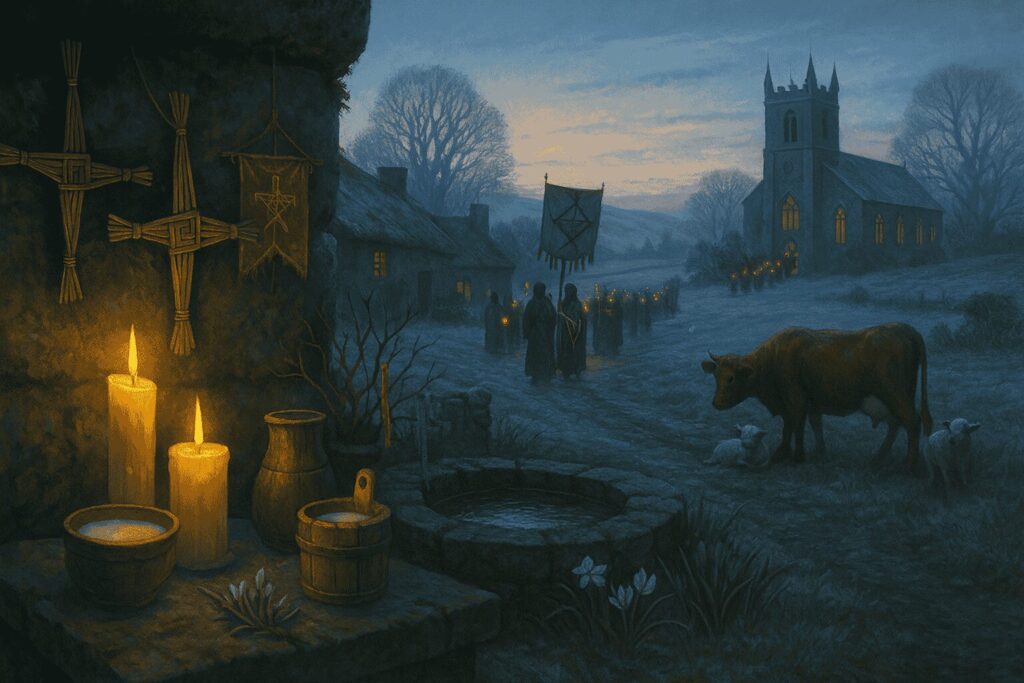
Three core images surround the Brigid Goddess in art and tradition.
The flame represents craft and inspiration, and even a small candle can stand in for that spark.
The well or a simple bowl of water symbolizes healing, a reminder of her link to sacred springs.
The anvil and smith’s tongs evoke transformation, and a humble iron nail can serve as a miniature symbol of that power.
Alongside these, many households in Ireland still hang Brigid’s cross, woven from rushes. That symbol comes from the saint’s tradition, yet it continues as a living emblem of protection and blessing.
Because both the goddess and the saint share these spaces, it’s useful to name which Brigid your practice draws from (mythic, saintly, or both) so the meaning stays clear.
Scholars call it “syncretism” when older traditions and Christian devotion overlap or blend.
With the “Brigid Goddess” story, that blending shows up everywhere: the goddess and the saint share a name, the same seasonal festival around early February, and values like hospitality, craft, and healing.
As a result, modern readers often encounter a combined picture that feels seamless.
To keep things straight, I separate the sources. If a story comes from the Christian saint, like the eternal flame at Kildare, I call it a “saint story”.
If it comes from the mythic figure, like her role as patron of smiths, poets, and healers, I call it the “myth stream”.
This way, you can enjoy both traditions without confusing the references.
A Brigid practice can stay simple with three objects: a candle for inspiration and craft, a bowl of water for healing, and a tool such as a pen or hammer to represent work.
Keeping them together on a tray makes the setup safe and easy to move.
The cycle is straightforward. Light the candle while focusing on a specific task – writing, mending, or polishing. Touch the water while calling to mind someone in need of care.
Then finish with a single line of verse or gratitude that ties to the skill in use.
Because the steps are short and repeatable, the ritual feels natural in daily life rather than staged. That practicality reflects Brigid’s role as a goddess of craft, healing, and transformation.
For safe candle work on a desk, I use a lidded, self-snuffing tin that travels well. Here’s one that works well: Desk-Safe Travel Candle.
Outside Ireland, “Brigid Goddess” appears under different names. In Scotland, she is remembered as Bride or Brìghde in songs and seasonal traditions.
In later English sources, “St. Bride’s” churches carry her name into city streets.
As communities migrated, they brought her feast days with them, so February abroad might be marked with food drives, candle blessings, or poetry nights.
Therefore, when a Scottish songbook mentions “Bride”, it refers to the same luminous figure.
The key is to notice whether the context speaks of the older goddess or the later saint, so the reference stays accurate.
People sometimes wonder if “Brigid Celtic goddess” is just a modern invention. The record says otherwise.
Early Irish texts describe Bríg or Brigit as a figure tied to poetry, healing, and smithing. Seasonal customs and place lore keep alive a February devotion linked to her.
And later, church and folk traditions preserve Saint Brigid as a force of hospitality and craft.
Because these threads come from different kinds of sources (myth, custom, and hagiography) they reinforce each other.
As a result, the figure of Brigid stands on multiple foundations, not just a single claim. That’s why the name still carries weight in conversation today.
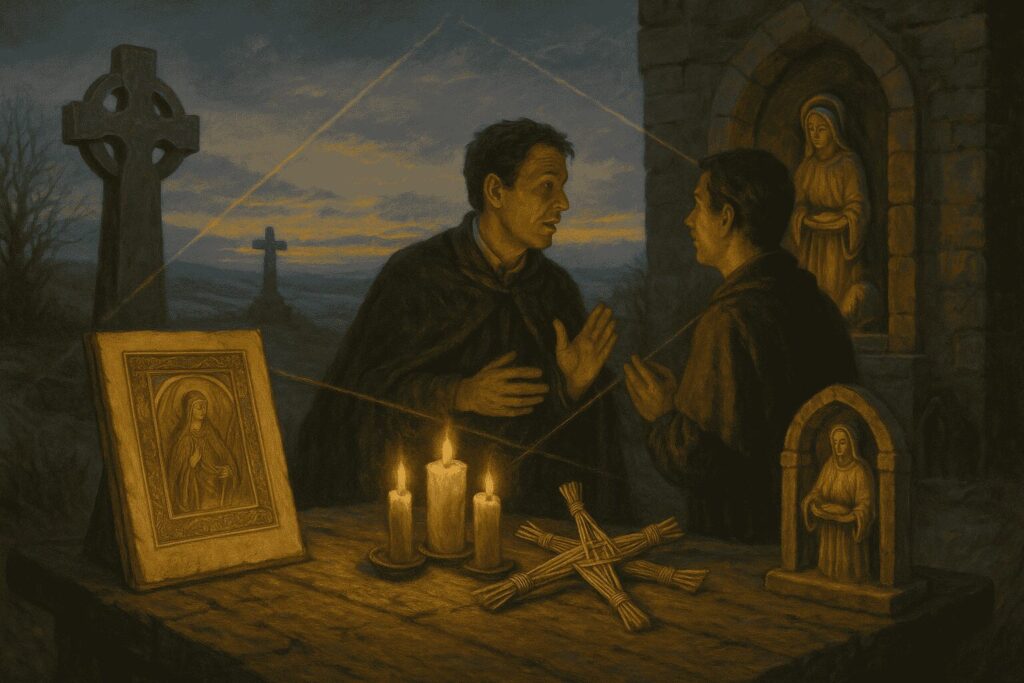
People sometimes ask if “Brigid Celtic goddess” is just something modern folks made up.
The answer is no.
Old Irish stories already name Brigid and connect her to poetry, healing, and smithing. Folk traditions kept her alive through seasonal customs, especially around February.
Later on, the church gave us Saint Brigid, remembered for her generosity and craft.
Because these pieces come from different times and sources, myth, folk memory, and church stories, they back each other up.
That’s why Brigid isn’t a new idea; she’s a figure who’s been carried forward in more than one way.
A common mistake is to mash every “triple goddess” idea into Irish lore. The texts about Brigid don’t describe her as maiden-mother-crone – that’s from a different tradition.
What we actually see in Irish sources is Brigid Goddess tied to poetry, healing, and smithing, sometimes even described as more than one figure with the same name.
Another mistake is to blur together the goddess and Saint Brigid as if they were the same.
The name overlaps, yes, and the feast date lines up with Imbolc, but the stories come from different worlds – myth on one side, Christian legend on the other.
It works better if you keep the two strands clear while still appreciating both.
The last big pitfall is quoting without sources. If you share a line, say whether it came from a myth, a saint’s life, or later folklore.
That way, anyone listening or reading knows the context, and the story holds together instead of turning into vague “Brigid said this” claims.
Is “Brigid Goddess” Irish or “pan-Celtic”?
Brigid’s roots are Irish, but you’ll also see her name show up in Scotland as Bride and in some British traditions. The exact meaning shifts depending on the place, so it helps to pay attention to context.
Is Brigid tied to the sun or the hearth?
She’s connected to the steady, useful flame, like a forge fire, the kitchen hearth, or a single candle, not the blazing sun in the sky. Think controlled warmth and craft, not a solar deity.
Why February?
Her season is early February because Imbolc, Saint Brigid’s Day, and Candlemas all fall right around February 1–2. That’s why so many customs involving light, milk, and craft bunch together at this time of year.
Do I need a shrine to honor Brigid Goddess?
Not at all. You can honor her by doing something simple with intention – write a short poem, light a candle while you work, tend a plant with fresh water, or help someone who needs it.
Small, practical acts fit her best.
You’ve now seen the Brigid Goddess from a few angles – the goddess of Irish myth, the saint who carried her name into Christian tradition, and the symbols that tie her to daily life: flame, water, and tools of craft.
You’ve also learned why calling her a “fire goddess” means steady, useful heat rather than wild blaze, how “Celtic” labels shift with region, and where her name still marks the calendar today.
That means you can talk about her clearly, set up a simple practice, and understand the overlaps without getting lost.
So here’s a place to start: pick one small task you can finish in an hour. Light a candle or safe flame beside you. As you work, write down one line of thanks for the skill you’re using.
Because meaning grows fastest through action, that simple gesture can make Brigid feel close by the time you’re done.