Physical Address
304 North Cardinal St.
Dorchester Center, MA 02124
Physical Address
304 North Cardinal St.
Dorchester Center, MA 02124

Elder Futhark is the oldest form of the runic alphabets used by Germanic tribes, primarily in Scandinavia and parts of the British Isles, from around the 2nd to the 8th centuries CE. It consists of 24 characters, known as runes, each of which has its own name and associated meaning.
When most people picture runes, they imagine sharp, angular symbols carved into wood, bone, or stone. These belong to the Elder Futhark, the oldest and most widely attested runic script in Northern Europe.
In this article, we’ll move step by step: first through the practical uses of the Elder Futhark, then into how the alphabet is organized, how scholars decipher inscriptions, and finally how people still apply runes in modern life.
Along the way, I’ll keep the explanations straightforward and simple. That way, each new term is clear as it appears, and you’re never left guessing.
The term Elder Futhark refers to the earliest complete runic set used by Germanic-speaking peoples, dating from around the 2nd to the 8th centuries CE.
The name itself comes from the sound values of its first six signs: f, u, þ (th), a, r, k.
When we talk about the Elder Futhark, we mean the full 24-sign system recorded on artifacts such as brooches, combs, spearheads, and memorial stones across Scandinavia and continental Europe – a lasting testament to the rich history of the region.
Since you’ll often see the word ‘alphabet,’ let’s clarify. The Elder Futhark is technically an alphabet, with each sign usually representing a sound.
Therefore, when you read “Elder Futhark alphabet,” think of it as a sound-based script, not as a hidden code or mystical system by default.
Later on, people added layers of symbolism to each sign.
However, those meanings came after the script’s original role as a writing system, which is why it remains both practical to study and culturally significant today.
The Elder Futhark alphabet has 24 runes, divided into three groups of eight. These groups are called ættir (singular ætt), which means ‘families’.
So, for example, the first ætt begins with Fehu (ᚠ), the second ætt begins with Hagalaz (ᚺ), and the third ætt begins with Tiwaz (ᛏ).
Because the runes are made of straight, angular lines, they were easy to carve into wood and stone. As a result, shapes like Fehu (ᚠ) or Thurisaz (ᚦ) worked well for carvers without splintering the material.
Each rune isn’t just a symbol, it’s a letter from the spoken language of the time.
That means when you read ᚠ = f, you’re not looking at something mystical, you’re looking at the actual way people wrote the sound ‘f’ 1,500 years ago.
This makes the Elder Futhark a real alphabet, not just a symbolic system.
When people ask about the meaning of an Elder Futhark rune, they usually want two things: the sound it represents and the symbolic meaning attached to it. To avoid confusion, I separate the two.
For example, ᚱ (Raidho) is simply the ‘r’ sound in early Germanic writing. That’s its job as a letter. Later on, traditions like the Rune Poems gave it a symbolic layer: travel, rhythm, or the start of a journey.
So when you hear ‘Elder Futhark rune meaning’, remember there are two layers at play. The first is the phonetic value – how people actually wrote and read it.
The second is the symbolic or poetic meaning, which grew over time. Both are valid, but I’ll always tell you which one I’m talking about.
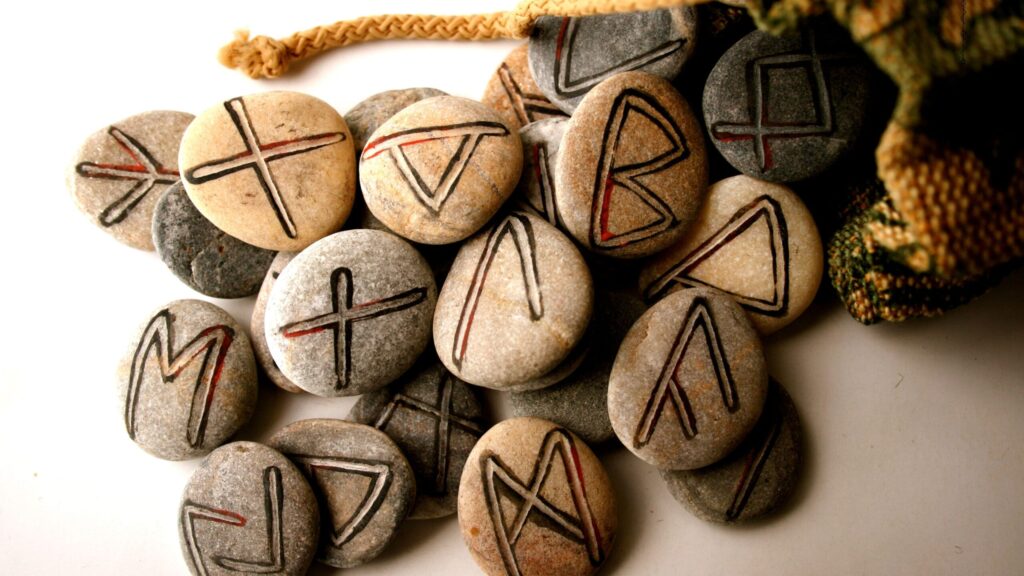
To keep this short and useful, here’s a quick tour. Each rune is listed with its sound (the phonetic value) and its traditional symbolic meaning (the theme).
This way, you can see both layers side by side without confusion.
When you read the list, you’re really seeing a quick map of the Elder Futhark.
Each rune shows both its sound and its symbolic meaning, so you can follow what it represents in speech and what it suggests in practice without confusing the two.
When people ask how experts can read old, weathered rune carvings, the answer is simple: context. Carvers often used repeated phrases, so scholars look for those patterns.
For example, if you see a personal name followed by a verb on a brooch, chances are it’s part of a formula that shows up on many objects. That pattern helps confirm the translation.
In addition, if the same sequence appears on two different artifacts, the repetition makes the reading even more solid.
Of course, rune shapes sometimes vary, but that usually means a stylistic twist, not a completely different letter. Because runes traveled with people, small regional quirks naturally developed.
Still, the core 24 signs of the Elder Futhark stay consistent no matter where they’re found. That stability is why experts – and you, once you practice – can read them across different regions and time periods.
When people explore the Elder Futhark runes, they usually want to know both what they meant in the past and how they might be applied today.
A simple way to approach this is to think in three steps.
First, see each rune as a sound, since the alphabet was originally designed for writing.
Second, recognize the symbolic idea that later traditions attached to it—images like fire, harvest, or journeys.
Third, if you’re interested in reflection, treat that symbol as a cue you can connect to everyday choices.
This way you can keep history, tradition, and practice in balance without blurring them together.
If you’re just beginning, it helps to work with a physical set of runes.
Wood or stone feels natural and connects you to the old carving tradition, while bone can look striking if you like something unique.
What matters most is durability and clarity – you want symbols that are easy to read and will last through practice.
For a simple starting point, a beginner-friendly Elder Futhark set with a clear guidebook is often the easiest way to dive in.
Your reading skills improve quickly when you copy proven methods. That’s why I recommend a simple routine.
To begin, choose a historical inscription from a reliable museum database or a well-regarded book. Next, write down the rune shapes and place their Latin equivalents directly beneath them.
This way, your eye learns to match the shape with the sound.
Then, read the sounds aloud while tracing each rune with your pen. Because sound and motion reinforce memory, this small habit builds fluency faster than silent study.
After a week of practice, move on to short words. For example, I kept a notebook with three columns labeled “rune”, “sound”, and “gloss” (a brief meaning).
Since the Elder Futhark rune alphabet only has 24 signs, you’ll rotate through the full set quickly.
Meanwhile, your eye will grow sharper, and before long you’ll be able to spot real words on real artifacts – a milestone that feels genuinely rewarding.
Because the internet is full of mixed claims, it’s easy to get confused. Therefore, when you see a page that promises “ancient spell meanings” for every rune, approach it with caution.
The earliest Elder Futhark inscriptions were practical writing – names, ownership marks, or short statements. Later, medieval rune poems attached themes and symbolic ideas.
In modern times, guides often expand those themes into reflective or spiritual practice.
Consequently, when I say a rune “represents the r-sound and evokes order”, I’m giving you two things: the grounded phonetic value and the traditional symbolic layer.
It’s all about understanding both roles clearly.
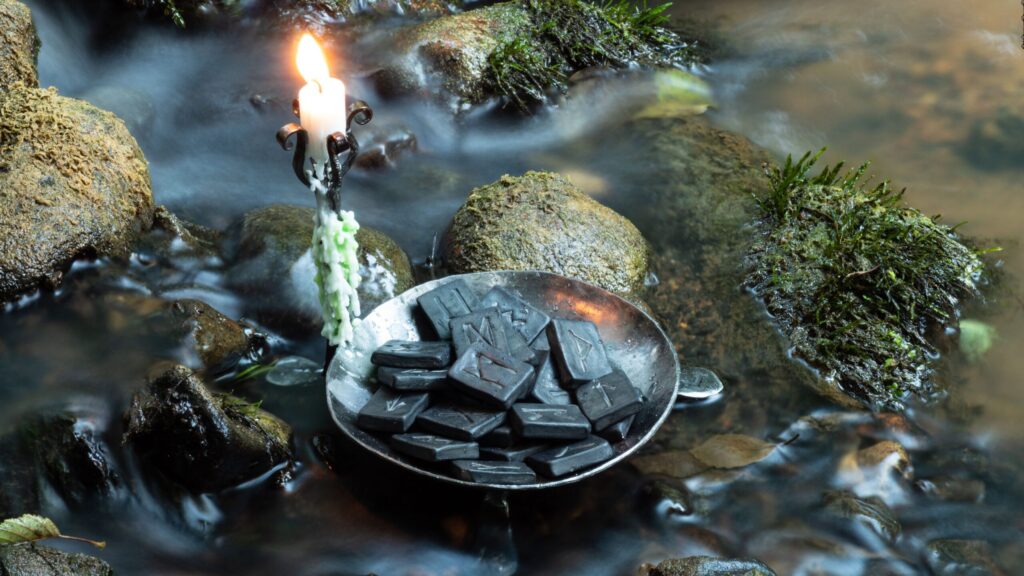
Today, many artists, writers, and designers use the Elder Futhark for creative work. Because the shapes are bold and geometric, they look striking on logos, book covers, and artwork.
However, if you use them this way, it’s important to respect their original context.
For example, when I design with runes, I match each sign to its historic sound rather than swapping it in as a direct English letter. Consequently, the result looks authentic and avoids turning into unintentional nonsense.
People often ask if the Elder Futhark is the same as the Younger Futhark used by the Vikings. The answer is no.
The Younger Futhark came later, reduced the system to 16 signs, and belongs to the Viking Age. Therefore, when you study the Elder Futhark, you’re looking at an earlier and more complete version of the runic script.
Another common question is about pronunciation. Because the sounds are reconstructed from historical evidence, scholars rely on comparative linguistics to make educated estimates.
Consequently, when a modern guide gives exact English equivalents, treat them as helpful approximations rather than a flawless match.
Finally, you may sometimes notice a typo online – “Elder Futhark meanin” without the final “g”. If you see it here, it’s intentional.
I mention it so that anyone searching that phrase still finds the correct explanation of Elder Futhark rune meaning, with the proper context and definitions..
Because consistency builds momentum, here’s a five-day micro-plan with clear outcomes so you can track progress.
On day one, write all 24 Elder Futhark runes in order and say each sound out loud. By the end, you’ll have a one-page reference you can keep at your desk.
On day two, add the names of the first ætt beneath each sign and recite them slowly. This locks in the first eight runes by both sound and name.
On day three, do the same with the second ætt. When you finish, you’ll have 16 signs secure in memory.
On day four, complete the third ætt and then read one short historical inscription with a published transliteration beside it. This introduces you to real source material.
On day five, write three simple words in runes from your own language, using their closest sound values, and then read them back.
This bridges ancient signs with modern use and shows you how the system works in practice.
By now, you’ve seen what the Elder Futhark is, how the alphabet is organized, how experts uncover rune meanings, and how you can practice without confusion.
Because we’ve kept sound values and symbolic themes separate in every example, you now have a solid foundation to build on.
If you want one quick line to hold onto, let it be this: the Elder Futhark is a 24-rune writing system with clear sounds, later symbolic layers, and a design built for carving into wood and stone.
As you continue, keep your study sharp by separating history from symbolism. When a claim is historical, check it against artifacts, dates, and inscriptions.
When a claim is symbolic, trace it back to the poems and note that you’re talking about themes, not facts.
Because you can hold these two tracks apart, your work will stay clear, your projects will stay respectful, and your creativity will stay grounded.
If you remember one final practice, make it this: keep your study small, steady, and spoken out loud each day.
Consequently, the runes will shift from feeling distant to feeling familiar. That’s the turning point – when the Elder Futhark stops being a relic in a museum and starts becoming a living practice in your own hands.